Start with the work.
Describe the question or document you need and identify the project information it should use.
TRACE MANAGEMENT SYSTEM
Tell TRACE what you need. Review what it prepares. Stay in control.
Construction management, with TRACE AI assistance. Connect project documents, RFIs, submittals, schedules, field records and payment review. Prepare the next step with your evidence, permissions and approvals in view.
TRACE FULL AGENT
Move from project information to prepared paperwork, with the evidence and your review in the same workflow.
Describe the question or document you need and identify the project information it should use.
Inspect prepared content, supporting references and any missing information before taking action.
Keep review, permissions and accountable approval at the point of action.
Full Agent expansion: final validation in progress. Expanded native-record and attachment workflows are being finalized. Request a walkthrough to confirm the released workflow for your team.
Prepare correspondence, summaries and supported project drafts from the information your team already has.
Follow supporting sources, review calculations and units, and see unresolved assumptions.
Bring specifications, trade subcontracts, pay applications and field logs into one accountable record.
MEET TRACE AI
Find the requirement. Understand the calculation. Prepare the next document. See what TRACE AI can help your team do—and inspect the details when you need them.
Ask a question, review the relevant passage and return to the source.
Inputs: supported PDF, Word, spreadsheet, presentation, image and structured-text files.
Outputs: summaries, relevant passages, stated decisions and requested actions, with supporting references when available.
Originals are preserved separately from extracted content. Large PDFs can process in the background. Extraction does not guarantee complete understanding of every page; review the original source.
Inspect equations, substitutions, units, assumptions and checks in supported workflows.
Supported paths check arithmetic and dimensional compatibility. Configured reasoning paths can compare independent formulations.
Review the assumptions and applicability for your project. Design decisions and approval remain with qualified, authorized reviewers; calculation checks do not establish universal engineering correctness.
Prepare source-backed records of added, removed and changed items.
Review supported drawing and specification material, retaining source context for comparison.
Proposed interpretations stay distinct from extracted facts. Missing geometry, dimensions and design intent require review; this is not a promise of exhaustive discrepancy detection.
Explore dependencies, calendars and baseline-versus-revised schedule evidence.
Implemented intake includes supported CSV, XLSX, XML and XER schedules, network evaluation and schedule comparisons.
Individual workflows require acceptance testing. This does not establish full Primavera P6 or Microsoft Project replacement or end-to-end format compatibility.
Prepare correspondence, meeting summaries, risk descriptions and review notes.
Adjust tone, structure and detail using supplied facts. Review the source information and any unresolved assumptions before use.
Drafting does not issue a notice, approve a decision or establish a contractual or legal conclusion. Consequential correspondence requires appropriate review.
Connect requirements, source revisions and field records into reviewable evidence.
Implemented export paths include PDF, DOCX, XLSX, PPTX and ZIP. Individual formats and layouts require workflow acceptance.
The knowledge library retains source revisions and searchable indexed passages. Capture, review, approval and evaluation remain separate. Adding a source does not automatically approve it or retrain model weights.
Specialized tools are available within their configured scope. Open a topic for the exact boundary.
Implemented tooling includes supported DXF/IFC intake, preserved originals, drawing inspection, bounded vector changes and supported geometry export. Closed DXF polylines can be extruded with a supplied height into OBJ geometry. Full DWG editing, exact PDF-to-CAD conversion and automatic reconstruction of complete buildings are not established.
Configured image generation/editing, visual inspection and OCR are supported routes. Speech input/output prioritizes English and Spanish acceptance testing. Supported Python, JSON and JavaScript diagnostics check syntax and security patterns without executing the submitted code. These are not authenticity certification, flawless transcription or comprehensive security audits.
Projects and saved conversations retain source context and execution history under current permissions. Authenticated APIs, scoped credentials and signed tenant requests provide integration paths. Administration includes source review, usage, indexing/storage visibility and supported job controls. Each consuming workflow requires live acceptance; ongoing security hardening is not a completed certification.
Explore the existing source-proof demonstration, or request a walkthrough of the capabilities relevant to your team.
TRACE AI capability overview · updated 11 October 2026. Configuration, permissions and workflow acceptance determine availability. This overview distinguishes implemented tools from broadly accepted customer workflows.
COMMERCIAL WORKFLOWS
Expansion capabilities now sit beside project controls, so teams do not have to move between disconnected systems to manage trade partners, commitments, approvals or closeout.
See the complete capability register ↗Maintain the responsible company, agreement and current qualification record together.
Prepare and track committed work with an accountable approval path.
Assign required fields and signatures while preserving the document history.
Connect the schedule of values, payment record, releases and handover evidence.
CHOOSE YOUR STARTING POINT
EXPERIENCE TRACE
Explore the actual interface through a limited demo account, or book a working session for project controls, risk management, CAD & BIM and advanced workflows.
SELF-RECOVERY
TRACE applies defined recovery rules to known failure states—stale work, interrupted processing, duplicate requests and quarantined inputs—while protecting the integrity of the project record.
When TRACE cannot establish that a write is safe, it refuses the write and records the condition for authorized review.
TRACE PROJECT INTELLIGENCE
TRACE connects schedule freshness, response clocks, contract coverage and evidence gaps in one explainable project-condition view. The gauge shows where attention is needed; the records below it show why.

PRE-CONSTRUCTION & PROCUREMENT
TRACE gives owners, public agencies and construction managers one governed path to define project requirements, collect evidence, route accountable signatures and hand the cleared record to the project manager.
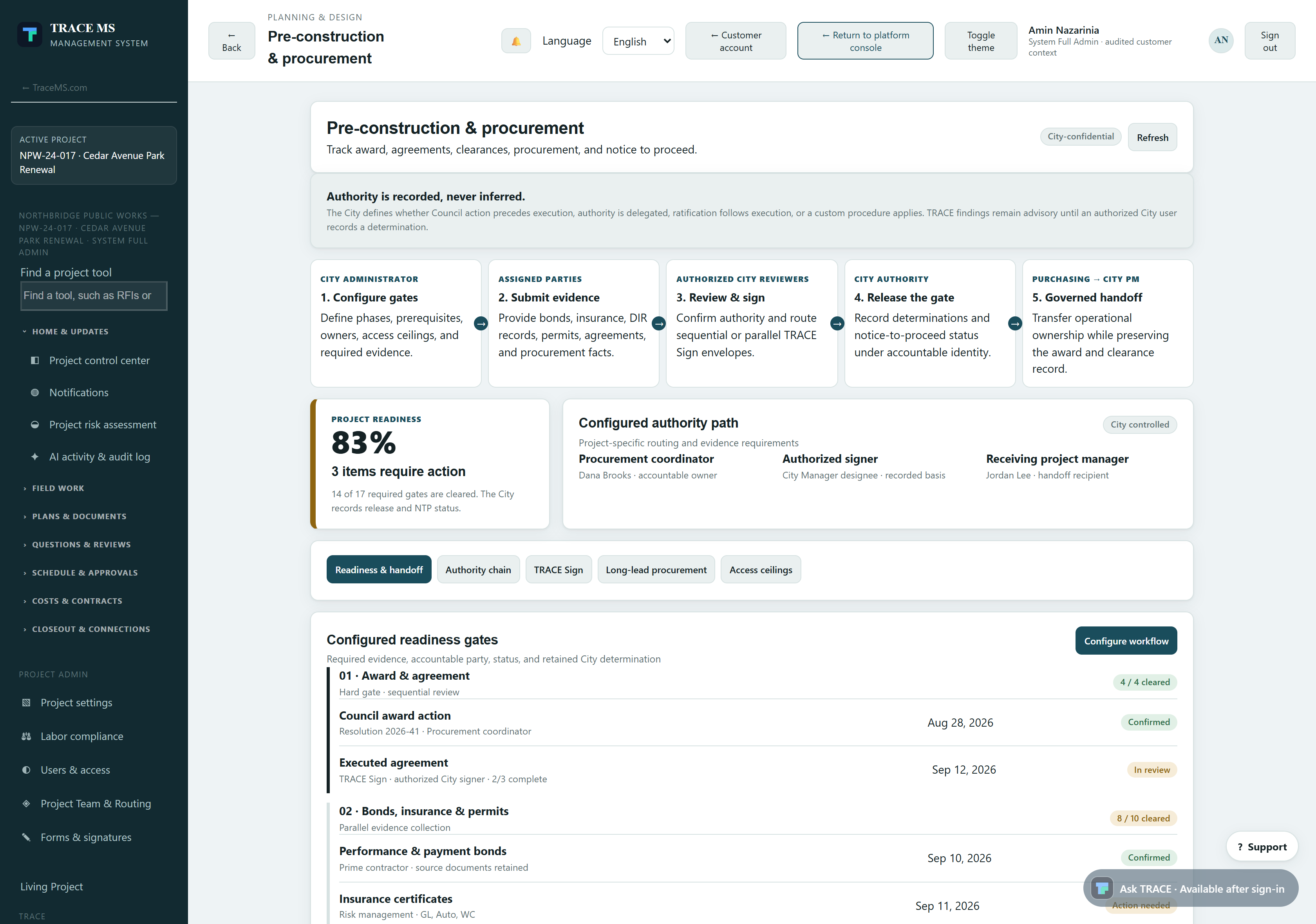
Authority is recorded, never inferred. TRACE presents project records and routes accountable decisions. The authorized owner or agency records applicability, acceptance, gate release and Notice-to-Proceed status.
SEE IT IN TRACE
See the TRACE workspace behind this capability, with its related navigation expanded and the project record in view.
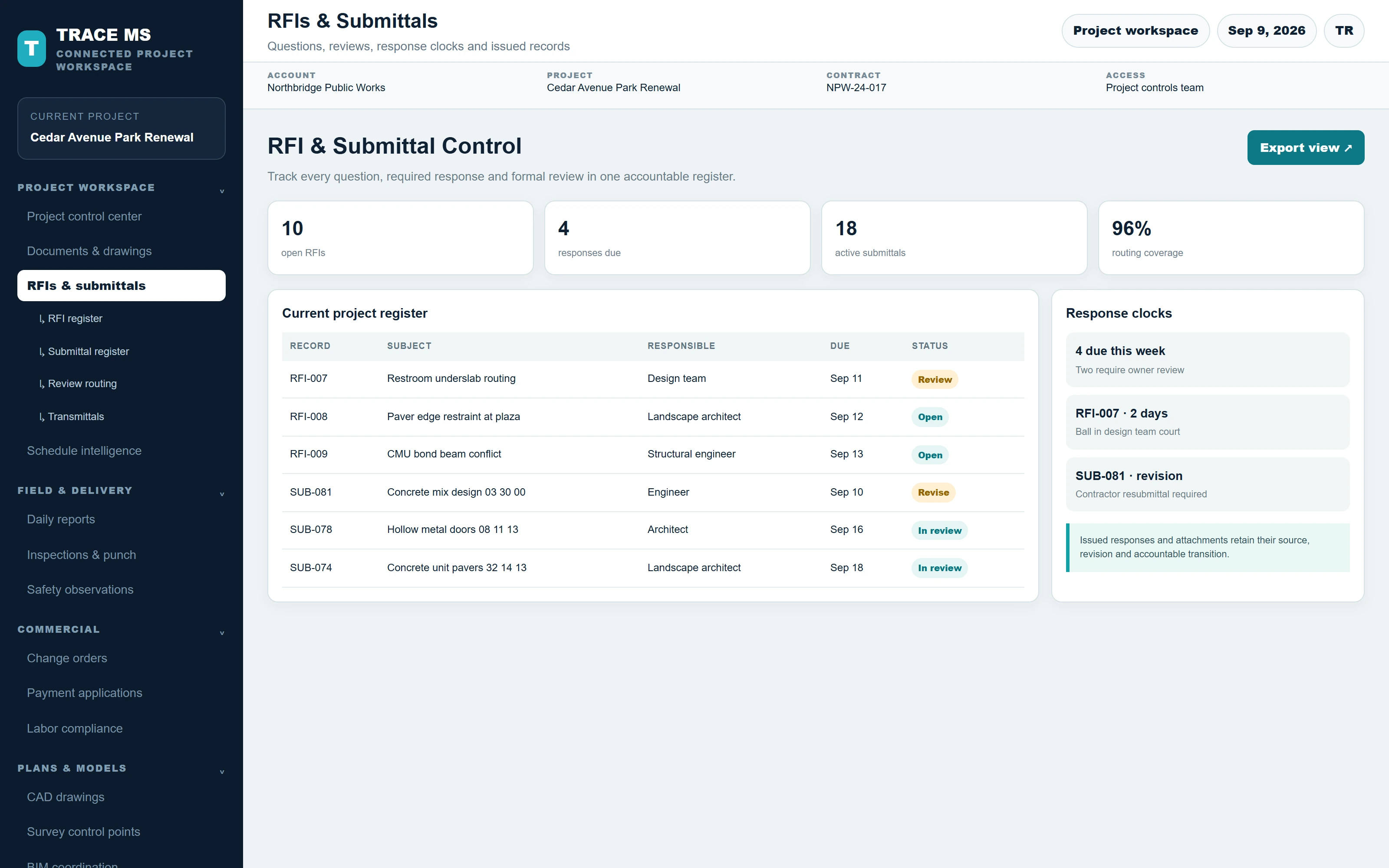
TRACE screens use controlled sample-project records; the survey-points view is captured from the existing grading drawing in the TRACE walkthrough. Every screen scales to the device width.
THE TRACE PLATFORM
Search the same 930 documented entries across 71 sections used by the full guide, including 34 platform access options. Available, conditional and development entries retain their scope notes. Inclusion depends on the selected plan, permissions, inputs and configuration.
71 sections · 930 documented entries (including 34 access options)
An organized workspace for owners, public agencies, construction managers, designers and contractors.
Module visibility depends on licensing and effective permissions. Device access follows the applicable client, browser and operating-system requirements.
Manage profile, password, organization identity and branding.
Create and open authorized projects; review active, closeout, archived and permitted trash views.
Use portfolio summaries and project selection to reach the right job.
Access project tools, current work, updates and available records from one starting point.
Use grouped navigation for home, field work, plans, reviews, schedules, costs and closeout.
Search navigation labels to locate a supported section quickly.
Open common records through account/project shortcuts.
See customer, project and current authority so actions are taken in the right workspace.
Assign participating organizations, project team members, roles and effective permissions.
Review notifications, assigned actions and AI activity/audit information.
Use contextual guidance and available interface language options.
Configure licensed project, organization and person-level access; device enrollment and operating-system permissions remain separate.
Keep responsibility, review authority and record history explicit.
Routes differ by record type and project configuration. A content seal records identity and attribution, not the correctness of an engineering judgment.
Maintain the job identity, participating parties and supported administrative settings.
Record contract details, notice to proceed and the relevant review/payment clock inputs.
Configure responsible organizations and supported review routes for each record type.
Separate creating, submitting, responding, reviewing, verifying and approving according to effective authority.
Identify the current responsible party and workflow state.
Use supported route and approval semantics with accountable transitions.
Preserve earlier route steps and decisions when a current route is amended.
Bind supported certifications and finalized records to their content identity and attribution.
Create eligible correction revisions while preserving original sealed RFI/submittal content.
Use configured templates and supported signing workflows with required fields and signing authority.
Retain attributable record and status history across governed workflows.
Bring supported project records into a current, permission-aware investigation workspace.
The Living Project workspace and the asset/sensor intake are complementary foundations. They do not currently constitute a fully synchronized operational digital twin.
Combine authorized RFIs, submittals, schedules, drawings, field observations and available energy records.
Show the age and coverage of available information rather than implying complete live awareness.
Identify supported missing answers, references, assignments and review information.
Prepare source-linked next-step drafts from selected findings.
Control eligible monitoring and learning through authorized opt-in settings.
Retain scan progress and handle eligible retry, resume, pause and stalled work.
Record accountable adjudications with source-version context.
Evaluate supported candidates against later records before adoption.
Activate supported tested workflow patterns under owner control.
Explore bounded imported-network scenarios and retain assumptions and calculation evidence.
Record energy, fuel and demand separately with units, time and source attribution.
Additional setup, commercial handoff and exchange functions included in the reviewed platform.
Configured agreements and signatures are not an unrestricted legal contract-authoring system. Generalized Workflow Studio, fleet/GPS intelligence and comprehensive offline resilience are not established by these functions.
Record supported sector, delivery method, contract duration and site coordinates.
Associate clock settings with the applicable source and delivery-evidence requirements.
Use eligible trash/recovery controls alongside archive and lifecycle permissions.
Track readiness, award/agreement clearances, authorities, organization policies and follow-ups.
Maintain supported procurement-item tracking and mobilization/NTP handoff information.
Record supported source calibration and measurements before relying on derived quantities.
Retain supported source-basis information with controlled estimate publishing and handoff.
Record acceptance/rejection, supported mappings, activity data and analysis history for imported versions.
Review payment-application findings and prepare supported accountant exports.
Maintain supported mappings, dry runs, approved exchange and reconciliation; an external provider must be configured and supported.
Use supported cross-project summaries and export under effective account access.
Apply licensed project, organization and person-level controls to eligible field-client operations.
Deployed on-demand foundation; its evidence compilation is distinct from a fully verified digital twin.
Continuum continuous compilation and integrated sealed-evidence verification are separate unfinished work. The released contract workspace has its own signed journal and portable archive; that does not automatically complete their integration into Continuum.
Compile accessible schedule, labor, change, billing, meetings, permits, safety, quality, daily and integration record state.
Distinguish facts about stored records from assertions in those records, unsupported proof and restricted registers.
Provide scoped database references with explicit unsealed status and bounded per-register coverage.
Distinguish submitted schedule versions from the recorded accepted schedule of record.
Expose absent records and domain evidence that has not yet been verified.
Prepare reversible proof-request text with the current brief attached only for an authorized preparer; no automatic sending or record insertion.
Download state, references, refusals, authority and draft/refusal as JSON with a payload SHA-256 fingerprint, not a digital signature.
Refresh state, reject stale results and explain restricted access without inferring authority from an administrator title.
Recent public-demo and account-reuse development.
The shared public visitor experience remains in preparation at this checkpoint. Synthetic examples are not customer work, physical inventory or completed approvals. Current update (September 9, 2026): the shared synthetic project is now published through private, seven-day, read-only visitor sessions. Uploads, edits, processing and live AI execution remain disabled. This supersedes the earlier preparation checkpoint in the source register.
Prepare one coherent fictional park/restroom project with linked construction records.
Populate ten fictional RFIs with supporting sample PDFs and source relationships.
Include CMU, concrete, doors, pavers and drinking-fountain submittal examples.
Provide labeled transmittal covers and a draft pay-application summary.
Populate multiple detailed change orders linked to the synthetic project story.
Populate baseline/update and look-ahead examples for read-only exploration.
Populate candidate permits and a multi-item field walk with related evidence.
Link fictional procurement items to submittals/activities and populate budget lines.
Assign and date the prepared preconstruction checklist in the demonstration.
Process the fictional BIM model through TRACE extraction; the recorded demo has geometry for 49 modeled objects.
Candidate visitor controls deny uploads, mutations, processing, live AI execution and unauthorized account-directory access.
Candidate visitor registration, verification, expiration and functional-demo request forms remain under integration acceptance.
Audit meaningful contents and detail views across 38 project sections; an HTTP success alone does not close the section.
Track section guidance, examples and training-video gaps separately from the sample data.
Recorded staging acceptance exports/imports a blueprint into a new tenant with empty destination business records.
Validate independent destination publication, authorized writes, suspended writes and cross-tenant denials.
Accepted on current isolated staging: expired setup link denied, normal password setup and correct-tenant login passed, and reused setup POST was rejected.
The corrected same-origin /app.html navigation passed normal-browser acceptance, including original-password login after attempted setup-link reuse and logout.
The synthetic project has an accepted-for-training MS Project XML revision with 25 activities, 34 finish-to-start links and 66 working days; the actual risk builder consumes it.
The real extraction produced 49 geometric products and 52 hierarchy/element records, published inside the synthetic project.
The newest demo additions include seven indexed PDFs totaling 18 pages, four plan sheets and four drawing images.
The demo owner corrected folder ownership and verified 46 of 46 files readable by the web-service user.
The synthetic project and records exist in a separate live tenant. Public visitor signup/access, full section acceptance and training remain separate work.
Evidence-grounded assistance for construction administration, investigation and preparation.
AI availability depends on the enabled module, configured provider and usage allowance. Fluent output is not evidence of correctness.
Ask typed or voice questions, including informal wording and follow-ups. Choose quick lookup, an answer with sources or detailed investigation; edit scope-specific suggested questions before sending.
Find screen guidance, navigation help and explanations of supported workflows through a separate product-help knowledge base.
Use authorized project documents and supported structured records as evidence for project questions.
Separate recorded facts, inferred consequences, assumptions, competing evidence and missing information.
Explain supported implications, highlight missing logic, calendars or baselines, and propose a next verification step.
Attach source references to supported findings; identify insufficient evidence rather than invent a project determination.
Supported queued assistance tasks prepare material in an authorized record context, subject to evidence and access controls.
Keep formal engineering, safety, legal, approval and permission-to-build decisions with the authorized person.
Retain AI activity, run identifiers, source context and supported review/feedback information.
Recover eligible long-running requests with the same request key and avoid duplicate model calls for repeated submissions.
Use supported voice entry/output subject to browser, device permissions and configured service availability.
Source selection is enforced before evidence reaches the reasoning model.
Shared general references and project-private evidence remain distinct. General references must be evaluated for actual project applicability.
Restrict retrieval to the current authorized tenant and project, with matching source and passage identity.
Search eligible shared reference material without carrying project context into that search.
Use the authorized project plus separately identified general references; do not mix in another project.
Project-only and combined project-bearing prompts do not use public web research. Permitted general research is a separate path.
Distinguish project records, reviewed references, general guidance and assertions; a reference is not automatically a governing requirement.
Retain available edition, jurisdiction and applicability metadata so the user can establish the controlling source.
Apply current access rights to records and evidence, including API and queued worker paths.
Clear prior questions, answers, citations and voice state when changing source scope.
Reject stale results after account, tenant, project, source-mode or relevant revision changes.
Keep failure curricula scoped and private; do not turn one customer's questions or project documents into another customer's knowledge.
Turn supported files into inspectable evidence while preserving their source identity.
Layout-oriented text does not preserve every visual relationship. OCR alone does not establish dimensions, scale, linework or design intent.
Extract supported born-digital documents into searchable passages with source and page context.
Retain extraction method, page identity and available confidence/region metadata for scanned notes and images.
Retain native PDF page numbering and layout-oriented text; open the original PDF page to verify tables, symbols and context.
Use content fingerprints and revision links to identify the exact evidence used.
Search relevant passages and supported structured project facts rather than treating all text as equally authoritative.
Open available source references and inspect the cited passage or original document.
Collect supported answer evidence into proof items for review and communication.
Preview, print or download supported exhibits, reports and source manifests.
Apply supported file validation, scanning and ingestion gates before protected evidence becomes usable.
Validate candidate hashes, page counts, page identity, empty/missing pages, safe paths and provenance metadata.
Add eligible references through extraction and quality review; preserve approval states and edition metadata.
The deployed reference expansion includes eight complete retained federal publications, totaling 524 PDF pages, plus 24 original TRACE workflow guides.
This is not an all-codes library. Referenced commercial standards are not included by reference. Full OSHA, FHWA and GAO libraries were not added by this expansion; full Greenbook fidelity was not newly certified.
UFC 3-501-01: electrical engineering reference material with page-linked source access.
UFC 3-410-01: heating, ventilation and air-conditioning reference material.
UFC 3-201-01: civil engineering reference material.
UFC 3-420-01: plumbing systems reference material.
UFS 3-740-05: construction cost-estimating reference material.
UFGS 01 32 01.00 10: project schedule guide specification.
UFGS 01 45 00: quality-control guide specification.
UFGS 01 35 26: governmental safety requirements guide specification.
Eligible existing Greenbook and selected OSHA reference records remain subject to their recorded rights, readiness and approval states.
Original TRACE guidance explains common processes. Eligible exact guide matches can return cited guidance without a model call; the complete title index appears later in this document.
Retained editions, original PDF links and extraction provenance identify what is actually in the deployed pack.
Prepare the next step while keeping issuance, approval and contractual decisions under human control.
A follow-up template is not an autonomous legal analysis. Autonomous bid-protest issuance and a comprehensive automated technical submittal compliance matrix are not delivered claims.
Investigate a question using authorized evidence and prepare supported wording or next-step guidance.
Generate an editable follow-up from the current RFI and workflow record; nothing is automatically sent or issued.
Prepare a structured review draft tied to the current record, with missing evidence left visible.
Rewrite submitted daily notes into an editable narrative with fact-preservation checks.
Use cited assistance to prepare questions and review material alongside the separate accountable submittal workflow.
Use supported drafting assistance with authorized context; review the controlling clauses and factual basis before use.
Prepare source-linked drafts from selected evidence gaps for an authorized reviewer.
Propose and evaluate bounded read-only investigation patterns from reviewed outcomes before owner activation.
An AI draft or recommendation does not itself approve a submittal, close an inspection, issue a notice or change the contract.
Interpret recorded project conditions and make missing inputs visible.
These are descriptive workload scenarios, not trained delay probabilities, proof of physical progress, legal causation or a guarantee of future performance.
Review supported project risk evidence, record context and identified gaps.
Show cumulative 7-, 14- and 30-day RFI/submittal review due horizons in the authorized confidential assessment.
Identify overdue, undated and aged actions without inventing missing deadlines.
Keep RFI and submittal completion rates separate, respecting current route cycles and parallel approvals.
Estimate remaining review workload only when the required positive completion history exists for each active record type.
Require at least eight positive completions spanning three of four weeks for each active type; return unavailable when the evidence is insufficient.
Exclude returned, rejected and future completions from the positive completion basis.
Highlight missing or stale accepted schedule evidence.
Read current structured workflow and schedule records when the assessment refreshes.
Keep confidential forecasts out of shared/compact views and reject results for a previously selected project or period.
Use selected images and a specific plan page to prepare a traceable visual review.
Delivered scope is assisted review of selected inputs. Automatic drone-feed monitoring, survey registration, measured alignment deviation, soil-condition diagnosis, automated takeoff from photos and certified installed-work verification are not established.
Submit supported field images and select the relevant PDF plan page for comparison.
Bind the review to the source plan revision and selected page rather than an unspecified drawing set.
Use the configured vision provider to analyze the selected image evidence and plan page together.
Present supported observations, uncertainty and information requiring field confirmation.
Retain the source references and review output with the authorized record context.
Add accountable review information rather than treating a visual suggestion as an accepted field determination.
Validate the provider's structured response, required shapes and completion state before admitting a result.
Use file and page extraction gates; preserve access boundaries across upload, analysis and replay.
Prevent a previous project's visual result from replacing the current view.
Improve selected workflows through measured, controlled changes rather than autonomous foundation-model training.
No autonomous model-weight training or unrestricted self-modifying code is deployed. Continued improvement needs maintained sources, new validated candidates and evaluation; it is not guaranteed every day or year.
Collect bounded failure signals into private, scoped evaluation curricula.
Use run references rather than publishing raw customer questions into shared learning material.
Evaluate fixed retrieval aliases for the original public workflow guides.
Compare a candidate on separate labeled cases before activating it.
Require preservation of previously passing cases for the eligible vocabulary candidate.
Avoid repeatedly tuning identical experiments against the same holdout; reject stale fingerprint selections.
Record source-versioned human outcomes for selected administrative findings.
Evaluate selected priority/calibration changes against later, different records before owner activation.
Test bounded investigation patterns before activating supported read-only workflows.
Process bounded scans, retain progress and recover eligible stalled work with retries, pause and health information.
Require the applicable authorization for activation, monitoring and return to baseline.
Deployed additions verified in the interpretation, schedule-reasoning, research and RFI release records.
Known limits include intermittent P6 answer-release failures, variable research latency, and saved chart caches that can be stale. These are not guarantees of universal answer accuracy.
Handle typos, shorthand, alternate meanings and standard-family hypotheses while retaining the original question.
Consider sequence, staging/access, crews, equipment, procurement, temporary works, testing holds, permits, handoffs, mitigation and counterevidence when supported.
Explain a standard as general guidance without requiring project adoption; keep binding project determinations separate.
Eligible general questions may continue to official public research when related local passages still cannot answer the question.
The documented difficult-general-research fallback uses gpt-6-astra after the primary provider cannot release a cited answer; this is an application component, not a TRACE-trained foundation model.
Validate citation ranges and Unicode offsets; reject incomplete provider output and unsupported assertions rather than releasing partial text as verified.
Distinguish research actually attempted from a setting merely being enabled; record provider usage and cost.
Provide authorized baseline/latest revision, disposition history, methodology, bounded activities/relationships, import assumptions and exact-version comparisons.
Examine overlapping delays, mitigation and completion impact; distinguish calendar days from working-time float and request missing CPM evidence.
Read saved XLSX/PPTX chart series, categories, values, labels, number formats and formula references. Do not evaluate formulas or follow external links.
Load subject, question and references from the authorized RFI ID; preserve linked follow-ups only while that project and RFI remain active.
Show proof, collect all eligible references, prevent duplicates and print answer proofs through an in-app preview.
Export supported complete text, tables, technical symbols, citations and eligible original source-page images without depending on the browser print dialog.
Reauthorize indexed passages; distinguish archived source evidence from public URL references that have not been archived.
Serialize/replay eligible requests by authenticated user and submission key; reject key reuse for a changed question and avoid duplicate model calls.
Implemented opt-in administrative improvement; activation and usable evidence are prerequisites.
Learning currently covers selected administrative RFI/submittal finding kinds. Metrics are observational and exposure-biased, not foundation-model retraining, physical verification or guaranteed improvement.
Retain explicit source-versioned human adjudications and append-only corrections within the project.
Evaluate on later unseen records rather than reusing the same source in training and testing.
Apply minimum distinct-record and reviewer-diversity/concentration requirements before eligible candidate promotion.
Compare eligible ranking candidates against baseline/current behavior, including per-kind regression and Brier-score checks.
Refuse candidate promotion from truncated history beyond the supported 2,000-review cap.
Invalidate dependent learning when source evidence is corrected or access is revoked.
Keep candidate activation explicit and permit return to the baseline.
Propose read-only investigation patterns from repeated substantiated outcomes; test later reviewed records before owner activation.
Use bounded source generations, durable cursors, fenced leases and atomic finding/checkpoint writes.
Process due projects with fresh authorization, retry/pause behavior and owner opt-out; do not treat platform support as unattended authority.
Compare supported paired readiness/duration scenarios and identify the next fact that reduces remaining uncertainty.
Detailed implementation distinctions retained from the AI audit.
Reference extraction is automated rather than named human fidelity review. Attempted but blocked GAO, OSHA 3886 and USACE CQM source downloads were not ingested. UFS is a nonmandatory reference and UFGS documents are templates requiring tailoring/adoption.
Offer bounded follow-up choices for broad construction questions without reading private evidence or spending model tokens.
Retrieve authorized daily, job-walk, quality, safety and time-record facts with operational citations.
Include clock settings only with explicit source, day count and working/calendar basis; do not substitute unsourced settings for contract terms.
Distinguish retrieval relevance from controlling authority, effective time, jurisdiction, project area/system/phase and amendment effects.
Retain exceptions, conditions, alternatives and supersession alongside direct matches; a classifier alone does not establish a legal conflict.
A separately configured reviewer can assess a draft against its cited passages without browsing, retrieving new evidence, adding citations or executing actions.
Capture corrections, rejections, no-match and escalation signals into a scoped curriculum. This shadow layer does not itself change live answers.
A fixed 31-alias candidate improved one small held-out top-topic evaluation from 14/18 to 15/18 while preserving eligible passing cases; this is not general answer accuracy.
Bind eligible activation to pack, dataset, algorithm and registry identities; corrupt or stale state falls back to baseline.
Count any-one review groups once at the earliest due action, all-required groups separately, and exclude inactive future steps.
The resource-recovery planner supports bounded unstarted fixed-duration DAGs with FS/nonnegative lag and ASAP/SNET releases plus explicit calendars. Unsupported SS/FF/SF, actual progress, splitting, overtime and inferred productivity are refused.
Rewrite supplied daily notes in English or Spanish while preserving facts, numbers, negations and uncertainty; do not add unsupported blame or causation.
Gemini, Grok and Claude consultations helped development reviews; they are not established as a three-provider vote on every customer answer.
Integrated customer-panel viewing and review controls; original source files remain preserved.
This is TRACE's internal review viewer/controller, not a full AutoCAD/Civil 3D/Revit authoring replacement. Section cuts are uncapped; camera ground/shadows are display aids, and geometry completeness remains source-dependent.
Open supported authorized PDF/image documents inside TRACE, navigate available pages and download the original.
Choose a current-project DWG and exact version, then open the converted drawing inside BIM without requiring an external CAD application for the supported review functions.
Select entities, search source handles, pan, zoom, fit, switch layers, restore converted visibility, add notes, draw polylines and measure approximate XY distances.
Orbit, pan, zoom and fit source XYZ line/point geometry; apply explicit Z-range, zero-Z and vertical-display controls. The 2D layer switches do not automatically filter this XYZ view.
Select one actual POINT layer, build the shaded surface, inspect low/high colors, toggle points/wireframe and apply maximum-edge and display-scale controls.
Use object tree/search, picking, selected-object fit, isolation/show-all, top/front orthographic views, isometric perspective, X/Y/Z section cuts, wireframe and reset.
IFC-derived GLB is served as a checked derivative; this does not establish arbitrary public GLB/glTF upload support or automatic mapping of every mesh to an IFC element.
Select actual points or separate block anchors, inspect original XYZ, export/print chosen rows and label a selected actual point as an unverified reference marker.
Bind viewing, annotations, evidence links and geometry to source/version fingerprints; reject stale or mismatched outputs.
Apply current source cleanliness, status, license and actor permissions; IFC publication and provisional CAD review remain distinct workflows.
Dispatch bounded native extraction, use private identity-bound caches, report supported/omitted geometry and recheck access after processing.
Prepare supported drawing, elevation, surface, coordinate and document-page outputs with applicable source identity, units and display settings.
DWG and IFC/IFCZIP have production review paths. PDF/images use document/markup paths. The richer direct DXF/3DFACE successor has accepted isolated staging integration; native RVT/DGN/SKP and arbitrary format conversion still require separate work.
TRACE review annotations do not rewrite the DWG/IFC design. IFC dimensioning, capped section solids, survey-certified benchmarks and approved final grading are not supplied merely by viewing.
Implemented release with 155 passing tests: 112 PHP tests (384 assertions), 37 voice tests and six browser fixture tests; TypeScript typecheck also passed.
The real-call result is one user-reported acceptance, not two independently identified calls or a statistical audio benchmark. Live research is a tested example, not universal accuracy. Human handoff is a ticket path, not a continuous staffing promise. No live charge, refund or subscription was attempted.
The response queue now waits while the caller speaks, coalesces overlapping turns and supports caller interruption. The user reported the real-call test passed as natural and responsive.
Explicit official-source requests bypass the original workflow-guide shortcut; literal exclusions of project records are respected while private identifier protections remain in place.
The tested RFI question returned official public-web citations to USACE CQM guidance and Caltrans Source Inspection Guidelines, with no project records used.
Get help now provides four current workflow guides, typed product guidance, clear source labels, retained inputs/errors and a human-ticket handoff path.
Web and telephone guidance covers My Apps/App Factory, Undo/Redo, loading, support, training and billing boundaries.
Completed a private cycle containing seven failure signals, two scoped curricula and two new versions. No model weights, live answer behavior or promotion changed; no autonomous training.
A read-only, secret-free check identifies missing merchant credentials, webhook configuration and plan setup. Live paid launch remains blocked pending configuration and financial acceptance.
Support guidance no longer triggers a legacy acceptance toast; topic selection does not approve or seal a project record.
Retained 24-guide pack; these are original workflow explanations, not adopted contract requirements.
Original TRACE guidance available to eligible workflow retrieval.
Original TRACE guidance available to eligible workflow retrieval.
Original TRACE guidance available to eligible workflow retrieval.
Original TRACE guidance available to eligible workflow retrieval.
Original TRACE guidance available to eligible workflow retrieval.
Original TRACE guidance available to eligible workflow retrieval.
Original TRACE guidance available to eligible workflow retrieval.
Original TRACE guidance available to eligible workflow retrieval.
Original TRACE guidance available to eligible workflow retrieval.
Original TRACE guidance available to eligible workflow retrieval.
Original TRACE guidance available to eligible workflow retrieval.
Original TRACE guidance available to eligible workflow retrieval.
Original TRACE guidance available to eligible workflow retrieval.
Original TRACE guidance available to eligible workflow retrieval.
Original TRACE guidance available to eligible workflow retrieval.
Original TRACE guidance available to eligible workflow retrieval.
Original TRACE guidance available to eligible workflow retrieval.
Original TRACE guidance available to eligible workflow retrieval.
Original TRACE guidance available to eligible workflow retrieval.
Original TRACE guidance available to eligible workflow retrieval.
Original TRACE guidance available to eligible workflow retrieval.
Original TRACE guidance available to eligible workflow retrieval.
Original TRACE guidance available to eligible workflow retrieval.
Original TRACE guidance available to eligible workflow retrieval.
Eight retained publications totaling 524 PDF pages. Editions below describe the retained pack, not a claim of current editions.
27 November 2024; 96 PDF pages; https://legacy.wbdg.org/FFC/DOD/UFC/ufc_3_501_01_2024.pdf
28 July 2025; Change 1, 23 January 2026; 63 PDF pages; https://legacy.wbdg.org/FFC/DOD/UFC/ufc_3_410_01_2025_c1.pdf
20 December 2022; Change 1, 1 June 2026; 68 PDF pages; https://legacy.wbdg.org/FFC/DOD/UFC/ufc_3_201_01_2022_c1.pdf
1 April 2021; 72 PDF pages; https://legacy.wbdg.org/FFC/DOD/UFC/ufc_3_420_01_2021.pdf
2 February 2026; 112 PDF pages; https://legacy.wbdg.org/FFC/DOD/UFC/ufs_3_740_05_2026.pdf
August 2026; 24 PDF pages; https://legacy.wbdg.org/FFC/DOD/UFGS/UFGS%2001%2032%2001.00%2010.pdf
August 2023, Change 4 August 2026; 51 PDF pages; https://legacy.wbdg.org/FFC/DOD/UFGS/UFGS%2001%2045%2000.pdf
May 2024, Change 2 August 2026; 38 PDF pages; https://legacy.wbdg.org/FFC/DOD/UFGS/UFGS%2001%2035%2026.pdf
Released advisory assessment controls added after the previous catalog.
Semantic interpretation remains model judgment. This is evidence-backed advisory assistance, not guaranteed legal correctness or an autonomous construction manager.
Split complete answer paragraphs and printable findings into server-created, hashed review units.
Include finding titles and applicability text in review rather than examining only selected snippets.
Return one review result per unit with source references, claim kind, assertion polarity and prerequisite states.
Reject omitted, duplicate or unknown units and evidence references outside the supplied source set.
Represent each condition as supported, contradicted or unknown; unknown does not become satisfied.
Require all stated prerequisites to be supported before releasing a positive assertion that they are met.
Allow an honest statement that acceptance or applicability is unproven without treating it as a positive claim.
Require each material summary or finding to retain its relevant conditions; another paragraph cannot silently repair an omission.
Block truncated answers and materially unanswered requests through explicit completeness review.
Avoid converting a reported execution or relevant document into verified incorporation, approval or controlling authority.
Do not infer that terms are legally nonbinding merely because their adoption evidence is absent.
A narrow guard checks identified suspension statements for supported notice and undisputed-invoice qualifications.
Supply passage text, source hashes, passage hashes and page locators to the reviewer.
Retain unit hashes, prerequisite outcomes, evidence references, expected counts and reviewer details.
Turn observed truncation, omitted conditions, false authority promotion and incorrect refusal into regression cases.
Claude, Gemini and Grok reviewed anonymized supplied sources and corrected reference wording; their acceptance applies to that wording, not certification of TRACE software.
The recorded final suite passed 19 adversarial reviewer cases and a complete live assessment; software checks covered 91 tests and 305 assertions.
Name the missing or governing records and the authorized person's next verification action before consequential decisions.
Organize files, drawings and daily records around their project context.
Text comparison does not compare all pixels or geometry. Forecasts are external observations, not proof that work was weather-delayed.
Upload, organize and retrieve authorized project files with source identity and extraction status.
Register plan sets and sheet records, including supported proposals from uploaded documents.
Review proposed sheets and bulk-register supported records with attribution.
Retain prior sheet versions and formal review context.
Select a supported PDF/image page, annotate it and use the authorized sharing workflow while preserving original bytes.
Compare extracted statements and metadata between authorized revisions of the same sheet.
Store project images and attachments with content provenance.
Capture field work, labor/equipment context and supporting media in the daily record.
Use supported signature/seal workflows and append corrections rather than overwriting finalized content.
Use project-coordinate forecasts, the current weather bar, ten-day outlook and source-linked weather notices.
Produce a deterministic cited position statement from supported sealed records and contract clocks, including freshness and explicit unknowns.
Additional document, knowledge and field-record tools included in the platform inventory.
Source verification status does not establish universal technical correctness. Access to the source administration tools is role dependent.
Upload eligible reference sources, track ingestion and manage source versions under the applicable authority.
Review extraction/readiness and verification status before eligible material is used as grounded evidence.
Maintain supported relationships between references and preserve provenance context.
Apply supported document/source classifications in addition to tenant and project permissions.
Keep unsafe or unready uploads out of the usable evidence path and expose supported status information.
Use supported large-file upload handling for project media.
Maintain descriptions, location metadata, collections, evidence links and previews.
Archive and restore eligible media under current authority.
Retain supported daily field records and printable daily outputs.
Prepare, send or void supported signature envelopes; delivery and provider availability are configuration dependent.
Deployed document-page editing improvements.
Restore up to 100 supported annotation changes, including grouped clear operations.
Invalidate redo after a new edit; retain native text-input undo behavior.
Reset markup history on project/source-version/page changes, cancellation and successful send.
Delivered RFI, document and tracker refinements from reviewed release records.
Viewing, previewing and printing do not issue, seal or approve records.
Bind the exact authorized RFI identity, subject, question and references to the conversation and retain that context only while the matching project/RFI stays active.
Display superseded responses as history while directing current action to the active correction.
Resolve recorded actors to names and timestamps instead of showing only internal identifiers.
Use the recorded issuing/originating and receiving organizations in the corresponding preview.
Use record-specific Preview / print RFI and Preview / print submittal controls and headings.
Retain explicit issued status and distinguish issued documents from generated previews.
Retrieve the submitted original under current account/project permission, with page navigation and download where supported.
Preserve the unchanged unsigned original while the supported review workflow creates separate signed copies for individual reviewers.
Keep intermediate signed review copies separate from the final seal after the last required approval.
Permit eligible project members to preview templates while requiring template-management authority for edits.
Create a new template revision without invalidating earlier assignments or signatures.
Use bounded upload chunks and finalized attachment identity to avoid duplicate or partial attachments; the recorded implementation uses 8 MB chunks.
Record unrecorded, confirmed or conflicting precedence with citations, ordered categories and conflict notes; do not silently choose between conflicting provisions.
Provide a self-contained printable document when an embedded host blocks the standard print window.
Give actionable feedback for empty generation prompts, tracker names, missing fields, empty labels and empty choice lists.
The deployed studio includes tested responsive layouts, keyboard access and reduced initial clutter on small screens.
The live demo location/weather correction provides current conditions and a 10-day forecast to the four configured demo roles.
Inspect real IFC-derived geometry and its relationship to the uploaded source.
Published IFC federation and cross-model issue coordination are included in this edition. Autodesk source discovery/import does not by itself establish native RVT rendering or automatic BIM-to-asset linkage.
Upload supported models to an authorized project container with an immutable version and source fingerprint.
Extract supported IFC identity, hierarchy, objects and properties through the conversion worker.
Find extracted elements and inspect properties with authorized project/version context.
Review, publish or reject model versions; viewing rights depend on authority and publication state.
Convert supported IFC geometry to a self-contained browser-viewable model.
Exclude Boolean cutter solids from displayed meshes while retaining actual host opening subtraction.
Show represented, converted, excluded-feature and missing-geometry counts, with an explicit completeness result.
Report available units and axis basis; display centering does not rewrite source coordinates.
Check original source bytes, derived geometry bytes, lengths and fingerprints against the version binding.
Recheck actor, project, version and status before serving verified geometry.
Import supported BCF 2.1 issues into the staging register and export authorized issues.
A construction-related example is automatically available from every project BIM panel.
Section cuts are uncapped visual slices. The synthetic example is IFC-derived, not a reconstruction from photographs or a survey-certified model.
Inspect the model using interactive camera controls and short animated view transitions.
Find and select individual rendered objects; display authorized names when available.
Highlight an object and frame the selected geometry.
Focus on selected geometry, then restore the complete model.
Move a cut along X, Y or Z to look inside the model.
Switch to top or front inspection views, or return to an isometric perspective.
Inspect mesh structure and restore the default view.
Use antialiasing, controlled pixel density, balanced lighting and ground shadows for a clear model display.
Abort obsolete loads and dispose viewer resources when the active scope changes.
Inspect conversion metadata and fingerprints; unavailable details remain explicitly unavailable.
Explore a three-storey public-works building with structure, glazing, doors, utility pipes and six opening voids; it creates no project records.
Deployed customer-panel capabilities added after the earlier public inventory.
Solid terrain is interpolated point coverage, not certified final grade. The reviewed grading file has separate point patches and missing references; approved proposed-surface identity, boundaries, breaklines, CRS and datum remain unverified.
Clean authorized uploaded DWGs appear in the current project BIM CAD workspace.
Open the selected drawing revision from Documents; keep original download and version history available.
Provisional review status no longer alone blocks the CAD viewer; viewing does not approve the source, bypass quarantine or widen access.
Convert supported DWG geometry through an isolated native worker; preserve original source bytes and report unsupported entities and missing references.
Pan, zoom, fit, show/hide layers, restore converted visibility and find/select supported entities.
Create notes, polylines and approximate XY distance annotations bound to the exact version and source fingerprint.
Retain saved drawing annotation history without overwriting the original drawing.
Inspect actual source line/point coordinates in 3D with orbit, pan and fit controls.
Choose a Z range, optional zero-Z exclusion and explicitly labeled 1x, 2x, 5x or 10x vertical display scale.
Build a shaded height-colored triangulated surface from one selected native POINT layer.
Show source-elevation ranges with blue lows and gold highs; optional wireframe and source-point overlays.
Report zero-Z exclusions, merged duplicates, conflicting-coordinate exclusions and triangle counts; refuse unusable or collinear input.
Optionally exclude triangles exceeding a selected edge length. Separate point layers are never automatically pooled.
Keep actual native POINT coordinates separate from block-insertion anchors; neither is automatically official survey control.
Filter coordinate candidates by layer/block, select rows and retain exact XYZ rather than substituting attribute labels.
Export selected coordinate rows with units, source/version and unverified status; escape spreadsheet-formula strings.
Mark a selected actual POINT with a visible reference label and XYZ; label remains unverified and does not establish an official benchmark.
Print current 2D, XYZ or solid-surface views and selected coordinate tables with source identity and applied display settings.
Abort obsolete loads and dispose graphics resources on tenant/project/source changes; recheck access and source integrity.
Deployed after the original 3D release.
These original single-IFC controls are retained. The deployed multi-model federation and cross-source issue controls are described in the new federation section. Native RVT authoring, geometric revision comparison, 4D simulation and automatic issue approval are separate capabilities.
Associate an exact IFC element/revision with an authorized RFI, submittal or schedule activity and record the reason.
Preserve link revocation history and recheck access to both model and target record.
Show added, removed and changed extracted identities/properties between two versions of the same model.
Show explicit associations potentially affected by metadata changes while leaving each link bound to its original revision.
Run bounded native geometric intersection checks between selected classes within one exact IFC revision.
Measure supported separation against the selected tolerance and return candidate pairs for human review.
Respect host opening subtraction and exclude Boolean cutter objects from the displayed products.
Report missing geometry and check coverage; incomplete zero-hit results cannot establish a no-conflict conclusion.
A separate newer DXF path now has coherent isolated staging and browser acceptance.
This successor does not replace the released DWG path in production. It does not establish arbitrary Civil 3D semantics, external-reference expansion, certified survey control or final-grade interpretation.
Retain explicit source points with exact source identity and original decimal provenance.
Retain source line endpoints rather than inferring design lines from rendered pixels.
Preserve explicit face vertex order and hidden-edge information where supported.
Carry declared units without silently assigning survey datum or coordinate reference authority.
Expose missing or unsupported references instead of silently fabricating geometry.
Constrain parsing by entity/vertex/output size, memory, CPU and wall-time limits.
Run the bounded parser with restricted filesystem/network permissions in the tested worker path.
Restrict the application-to-parser interface to its authorized local caller.
Bind listener ownership and recovery to its recorded process/socket identity.
The accepted disposable integration tested listener termination, recovery and subsequent parsing.
Do not recover an unproven socket/listener identity or crash before durable ownership metadata.
The later isolated staging release passed real Documents upload and CAD review.
Staging browser acceptance covered one POINT, LINE and 3DFACE, source limits and TRACE-branded print output.
Bind the accepted staging CAD revision to its encrypted backup/transfer receipts.
Newer verified additions received from the demonstration development owner after the main catalog refresh.
The converter and synthetic project remain part of the catalog. The public website now reports private, time-limited, read-only demonstration sessions. Synthetic geometry is not survey authority or contract approval.
A native DWG is admitted in the separate synthetic project, with 651 terrain POINT coordinates matching the authored CSV, one explicitly unverified reference point and 656 rendered entities.
An installed narrow LibreDWG exporter patch preserves layer visibility instead of negating all layer colors and hiding otherwise visible drawing layers.
Both visible-layer and deliberately hidden-layer fixtures passed, together with the real production sandboxed preview under the web-service user.
Scoped local viewer acceptance verified 49 mesh loads, IFC tree selection, isolation, fit, top projection, wireframe, section cut, search and source checksum.
The synthetic project includes a draft preaward profile and a ten-item estimate, with all ten items linked to plan versions.
A synthetic draft envelope contains two fictional recipients, unsigned fields and a two-page PDF; it is not an executed customer agreement.
Ninety media/document-version file readability, hash and size checks passed for the synthetic demonstration content.
Manage the formal exchange of questions, responses and review packages.
Draft generation and document export are separate from sending, issuing or approving a record.
Track questions, subject, responsible parties, references and current review status.
Associate specification sections, plan references, related submittals and governed attachments.
Record the authorized response, route it through configured review and retain sealed history.
Organize packages by specification section, assigned parties and review clocks.
Capture dispositions, review stamps, certifications and accountable finalization.
Preserve supported original/unsigned material alongside the accountable review record.
Produce supported RFI, submittal, change-order and payment-application covers from the record and account branding.
Maintain append-only issued-document history and source associations.
Prepare agendas, record minutes and action items, and finalize supported meeting records.
Preview or print supported records and prepare communication through the configured workflow.
Connect structured observations to a protected project record.
Gateway deployment and actual hardware onboarding are required. No production hardware calibration, anomaly control, general municipal feed, live CSLB/DIR connection or full operational digital twin is claimed.
Register an asset with an immutable sensor channel, metric and unit.
Enter attributable readings with measurement time and declared units.
Accept authorized client readings with project and tenant checks.
Validate decimal precision, time bounds, metric and unit identity; reject conflicting or mismatched observations.
Use UUID idempotency and sensor/timestamp deduplication to prevent replayed readings from multiplying records.
Issue, rotate and revoke scoped sensor credentials with bounded expiry and one-time raw-token display.
Check issuer rights, license and project lifecycle at intake; credentials cannot silently switch channels.
Delivered gateway software supports durable buffering, fixed-identity retries, QoS 1 acknowledgment and verified TLS.
Keep attributable manual energy, fuel and power-demand readings with units, time and source references.
Look up an exact issued-permit number in the supported official dataset and display source/status/check dates separately.
A lookup does not itself update a project's issued status or establish legal applicability.
Record findings and route accountable follow-up through the project.
These workflows support accountable administration; they do not independently certify site safety, statutory compliance or permit applicability.
Capture supported inspection records and evidence.
Describe issues, assign responsibility and track follow-up.
Maintain completion items and evidence-backed closure under the applicable authority.
Record field walks, observations, due dates, responsible parties and accountable finalization.
Require the supported human determination; a party claim or AI recommendation cannot close an item on its own.
Capture unsafe-condition reports and corrective actions.
Maintain incident/near-miss records and human recordability determinations.
Record supported safety talks, training and participation evidence.
Use country/jurisdiction-aware candidate screening with editable federal, state/province and local entries.
Record a project-specific basis for permit applicability.
Require supported clean evidence for issued status and preserve determination history.
Browser evidence capture has a separate identity and review chain from native draft synchronization.
Physical iOS/Android acceptance and comprehensive offline drawings, RFIs, schedules and approvals are separate. A disconnected device learns revocation only after contact; local expiry remains important.
Enroll a project-scoped capture key through authenticated controls before offline use.
Verify returned receipts against the previously pinned signing identity.
Bind original files and observation metadata to a signed capture manifest.
Keep signed originals on the enrolled browser while disconnected, including tested browser restart scenarios.
Maintain device-chain counters and avoid treating an older capture as new.
Clear eligible pending items only after validating the server receipt.
Retry an uncertain capture with the same identity after a committed response is lost; avoid duplicate evidence.
Export a protected recovery backup using a user-held passphrase.
Recheck device authority when reconnecting and retain refused originals for controlled recovery.
Distinguish the original signer from the person recovering the backup.
Keep recovered originals unreviewed until the authorized inspection and review path completes.
Require the configured scan/inspection result before recovered evidence can be accepted.
Prevent original submitters and recovery operators from self-accepting the recovered evidence.
Allow an authorized reviewer to inspect exact recovered bytes before recording a review.
Recovery does not silently reactivate the revoked device.
Serve the cacheable capture shell and JavaScript modules with the required routing and MIME behavior.
Combine deterministic schedule analysis with bounded alternatives for authorized review.
Legacy rehearsal uses abstract elapsed minutes; recovery is a separate constrained planner. Neither guarantees a global optimum, constructability, Monte Carlo probabilities or automatic write-back to P6/MS Project.
Read CSV, XLSX, MS Project XML and Primavera P6 XER exports through supported parsers.
Retain source identity, import assumptions and authorized version comparisons.
Inspect supported critical-path calculations, relationships, gaps and version deltas.
Prepare three-week look-ahead drafts with constraints, accountable transitions and export.
Compare up to four user-supplied network alternatives for duration, release and dependency changes.
Generate four fixed-priority heuristic proposals for eligible complete, unstarted networks of 1-200 activities and up to 1,000 supported relationships.
Evaluate supported work periods, closures and dependencies in the recovery planner.
Respect declared labor/equipment capacities and material-release constraints in supported recovery cases.
Show direct work costs based on the supplied rates and inputs, rather than inferred project margin.
Inspect original source semantics; refuse unsupported logic, ambiguous defaults, actual-progress recovery and unrepresentable constraints.
Show assumptions, finish effects and relevant calculation evidence without modifying the imported schedule.
Exportable review material and controlled improvement.
A portable evidence archive is not a complete infrastructure backup. Procedure learning does not train foundation-model weights.
Include an explicit registry of supported project record families and flag coverage gaps.
Retain newer change-order fields and associated asset, sensor, visual-review, BIM-link and CAD-markup records.
Verify that supported polymorphic evidence targets are represented rather than silently omitted.
Exclude stored credential hashes and secrets from portable evidence packages.
Check selected file identities, bytes and hashes against the archive manifest.
Release a complete marker only after record registry, file and coverage checks pass.
Provide verifier resources for checking signatures and package consistency separately from the interactive portal.
Identify an external URL as a reference rather than implying its remote content is included in the archive.
Use the appropriate relationship and working-time basis in supported schedule rehearsal.
Retain the selected progress/remaining-duration assumptions in the scenario packet.
Bind the signed rehearsal to its exact source, assumptions and result.
Preserve complete row content across multiple printed pages in the tested packet path.
Build procedure candidates from expressly reviewed outcomes and their required evidence types.
Evaluate a proposed procedure against held-out examples and current source requirements.
Require authorized activation of a candidate rather than automatically changing live behavior.
Retain history while stopping future use of a retired version.
Prepare unsent review steps for a selected authorized source record.
Connect billing, cost and change records to their supporting evidence and authority.
Legal and financial determinations require the controlling project terms and authorized review. Recorded credential windows are not a live licensing-board verification.
Structure progress billing and maintain supported line allocations.
Prepare progress applications with supporting records and review/payment clocks.
Use supported content-bound, two-person certification and structural validation.
Track supported withholding amounts separately from the operation of the payment clock.
Keep approval and contract incorporation as distinct actions.
Associate approved changes with SOV allocation while preserving the original contract value.
Maintain budget, commitments, actual cost, forecast and variance records with attributable revisions.
Record crew and equipment hours by cost code with supported approval.
Maintain project partners and subcontract records.
Evaluate entered license, registration, bond and insurance effective/expiry dates against the recorded work date.
Manage configured release records and claimant exposure.
Track notice-related withholding separately from release exposure.
The tested package was deployed September 8, 2026 Pacific time. Existing workflow behavior and grants were preserved.
Workspace is enabled. Mandatory new evidence gating on existing workflows is off; explicit evidence acceptances remain enforced. This release does not supply automatically approved jurisdiction rules or activate merchant billing.
Connect supported formal record actions to explicit evidence acceptance, current source and authority checks, transaction locking and retry identity.
Maintain append-only, project-bound events, source relationships, configured evidence policy, cryptographic signatures and independent review.
Enroll/revoke capture devices; sign local originals, pin receipt keys, retain offline queues, encrypt recovery backups, synchronize and quarantine recovered evidence for independent review.
Use working-day and relationship-lag calendars, progress methodology, remaining durations and source-linked scenario packets.
Record reviewed outcomes, evaluate candidate procedures, explicitly activate/retire versions and prepare unsent record-specific checklists.
Export registered project records and eligible original files with credential exclusions, byte checks, signed coverage manifest and an independent verifier.
Detailed components of the released contract workspace.
The deployed workspace does not automatically approve a source, issue a notice, send payment, adopt a legal rule or grant new access.
Import authorized facts from RFIs, submittals, changes, payments, schedules, quantities, quality, meetings, labor, safety, procurement and reviewed passages.
Bind imported evidence to a configured project organization rather than accepting an invented party.
Record supports, requires, contradicts, measures, implements, responds-to and derived-from relationships.
Retain the previous revision and correction reason rather than overwriting evidence history.
Record withdrawal or control events while preserving historical references.
Recheck current source identity before proposals, relationships and accepted decisions.
Refresh user and grant state without discarding the device-bound token context.
Bind a proposed acceptance to its target, command content and source state.
Serialize relevant decisions and source corrections with scoped locks and transaction checks.
Return the prior result for an identical accepted request and reject reuse with changed content.
Detect changed account, project, form content or decision options during asynchronous lookups.
Keep ordinary approval behavior intact while mandatory evidence enforcement is disabled.
Validate an expressly supplied contract acceptance even in continuity mode.
Support evidence acceptance at bid award, takeoff acceptance, accounting exchange approval, lien confirmation and stop-notice resolution.
Bind ordered project events to previous hashes and a server signing identity.
Configure timezone, working weekdays, exceptions and dated nonworking days.
Preview versioned rule changes against source-linked project evidence before publication.
Retain the exact reviewed pack, effective dates and publication history; do not silently inherit a changed rule set.
Show available controls from current capabilities while keeping restricted source facts out of the projection.
Add journal/review structures while preserving existing records; destructive history rollback is refused.
Support configured public-works and project-specific labor evidence workflows.
No universal live wage-rate feed, autonomous trade classification or blanket legal-compliance guarantee is included. Time cards and certified-payroll review remain distinct processes.
Configure the applicable project requirements and supported California public-works / PLA / CWA settings.
Track required submissions and project-specific evidence.
Receive attributable subcontractor compliance submissions.
Record supported registration/receipt information for review.
Compare reported classifications against supplied, cited rate determinations; flag unknown or missing classifications.
Track DAS 140/142-related evidence and supported requests.
Review configured ratio information against submitted records.
Track supporting contribution evidence.
Maintain agreement/dispatch-related records where required by the configured profile.
Track supported project workforce and hiring commitments.
Use deterministic checks to identify gaps and document human resolution.
Prepare procurement and contractor estimates while preserving controlled access.
Procurement profiles are configurable workflows, not determinations that a bid, classification, protest or award is legally compliant.
Maintain supported readiness records and qualification information.
Configure public or private operating workflows for the project.
Prepare and manage supported solicitation records.
Track procurement amendments and associated documents.
Use supported bidder invitation and controlled bid-room workflows.
Receive and retain bid submissions through the configured process.
Keep award decisions with authorized people.
Associate supported quantity work with the source evidence used.
Build supported estimates with cost-code and cost-basis information.
Maintain supported internal quote and comparison information under contractor access controls.
Move an authorized estimate through the supported controlled handoff process.
Do not expose internal estimates, quotes, budgets or leveling merely because an owner also uses TRACE.
Create supported custom trackers and manage attributable stock movements.
App Factory generates constrained definitions, not arbitrary executable programs. It does not automatically purchase material, post ERP transactions or connect external systems.
Describe a supported form or tracker and generate a reviewable constrained definition.
Configure supported field types, validation and references.
Define supported simple states and transitions.
Add supported charts over application records.
Inspect and edit the generated definition before publication.
Use app-specific builder and publisher authority to release a supported revision.
Open published applications and create or manage authorized records through the installed web runtime.
Separate viewer, editor, builder and publisher grants.
Restore an eligible prior valid published definition when required.
Record receipts, transfers, issues and reversals with fixed-precision quantities and attribution.
Inspect stock movements and supported reconciliation records.
Link supported custom records to inventory items without automatically posting a stock movement.
Additional lifecycle functions behind the custom-application and stock-ledger workspaces.
These are validated application-data workflows. They do not establish arbitrary code execution, generalized ERP automation or fleet telemetry.
Start from supported catalogue definitions or reusable templates.
Retain editable drafts before publishing a valid application definition.
Exchange supported application definitions through validated blueprint workflows.
Inspect supported schema/definition changes before applying an eligible migration.
Apply supported changes through the controlled application lifecycle.
Create, update and delete eligible custom-app records under app-specific permissions.
Find records in supported custom trackers without loading the entire record set at once.
Relate supported records across authorized custom applications.
Use supported record summaries, charts and dashboard layouts.
Inspect app definition/runtime state and use supported recovery-draft or repair operations.
Maintain item/location registers and opening-stock preview/application.
Review balances and attributable movement history across authorized locations.
Deployed web tooling with provider generation subject to current pricing, usage and service readiness.
Client access follows the applicable browser and device requirements. Whole-tracker deletion and unrestricted executable generation remain separate from these supported tracker controls.
Describe, review, save draft and publish through a four-step process.
Find trackers using library search and draft/published filters.
Add, remove and reorder typed fields without silently replacing stable field keys.
Preview a generated design and submit practice entries without creating business records.
Preserve paragraphs and Unicode through preview, creation, editing and reload.
Confirm deletion of the named selected entry with Keep entry as the safe default; this is not whole-tracker deletion.
Supported new-account paths receive one account-local SAMPLE inspection tracker with 15 fields, four transitions, a chart and a fictional record; existing accounts are not universally backfilled.
Avoid duplicate samples and preserve user edits, deletions and revoked grants; eligible later members receive sample-specific access.
Recover eligible valid published definitions and repair derived indexes without inventing replacement business records.
Earlier production generation passed, but later pricing/reconciled-usage gates blocked a tested request. Generation is implemented and conditional, not guaranteed available to every account.
Preserve the operating record and configure external exchange deliberately.
Named integration catalog entries are not proof of active adapters. SSO/MFA/SCIM, enterprise certifications, failover and restore guarantees require separately verified delivery terms.
Assemble evidence-backed turnover requirements and track completion.
Record accountable closure rather than inferring acceptance from an export.
Create supported record snapshots with a sealed manifest and content fingerprints.
Retain supported read-only archived records for authorized access.
Use the deployed versioned, authenticated customer read API and developer OpenAPI contract. Current project grants, supported record types, pagination and protected photo retrieval govern access. See the detailed API section in this edition.
Maintain supported provider setup, mapping and connection-health information; unavailable adapters remain unavailable.
Export supported records, manifests, proof reports and exchange formats.
Enforce server-side scope and effective permissions across governed endpoints.
Retain supported audit events, sealed content identity and linked corrections.
Manage supported account/module licensing, grants, AI usage and operational settings.
Use product help and supported support workflows; configure email, retention, backup and external connections for the deployment.
Separate billing technology from the construction capability inventory.
Paid self-service launch is not accepted merely because sandbox objects or subscription routes exist. Quote-based public pricing and actual provider readiness remain relevant.
Corrected provisioning checks distinguish subscription activation from verified completed payment and enforce plan mismatch guards.
Implemented receipt/account/encrypted-mail enqueue and retry controls are documented.
Sandbox OAuth, catalog and checkout creation are recorded; end-to-end buyer approval, webhook activation, delivery and live launch acceptance remain incomplete.
Browser access, released native-server contracts and continuing installed-client development are distinct delivery paths.
Device project enumeration and signed draft synchronization APIs are released. This does not establish App Store/Play distribution, complete native parity or offline formal approvals.
Windows and Mac can use supported browser workflows. A Windows application with a separate protected native draft workspace and isolated online portal window is undergoing installed acceptance.
iOS and Android have native-client development, shared interface and bridge work. Signed distribution and physical-device acceptance must be confirmed for the applicable release; supported browser access remains separate.
Microphone, camera, file selection, downloads and notifications follow the device/browser permission settings.
Interactive CAD/BIM requires compatible graphics support; provider-backed and connected workflows require the relevant network/service connection.
Updated by the September 9 AI/operations release: interruption handling corrected and a user-reported real-call acceptance passed.
The earlier interruption issue is superseded by the documented fix and user-reported natural, responsive real-call result. Device, network and conversation conditions still affect call quality.
Configured telephony gateway connects caller audio with a realtime AI conversation service.
Provide TRACE product/help knowledge through the configured voice service; this does not establish unrestricted project-document access over telephone.
Manage conversation-turn behavior and response-length settings to reduce interrupted or unfinished speech.
Collect timing/completion telemetry for audio-gap diagnosis without recording audio or transcript text in that diagnostic.
The current operations/help gateway passed 37 voice tests and TypeScript checks. Its audio/queue code matches the real-call-tested version.
Development history remains visible. Later production receipts supersede earlier candidate-only descriptions.
Some staging/candidate areas continue to change. Only a scoped acceptance/deployment receipt can promote their availability status.
Released for the supported bid-award, takeoff, accounting-exchange, lien-release and stop-notice paths. Explicit submitted acceptances are validated; mandatory gating of existing workflows remains disabled.
Released customer device recovery/revocation, reviewed-procedure activation/drafting/retirement and jurisdiction-pack validation. Project policy and legal-rule content still require authorized configuration.
Validation machinery does not supply approved legal rule content; authoritative pack review remains outstanding.
Direct POINT/LINE/3DFACE extraction, restricted parsing, listener recovery, Documents opening and printing passed isolated staging acceptance. This successor is distinct from the production DWG viewer.
Current isolated authentication, encrypted capture/restore, scoped regional-independence and backup recurrence evidence exists; full current-region production promotion/routing/write survival/failback remains unaccepted.
Multi-model IFC federation is deployed with explicit transforms, source identities and review controls. Licensed native RVT translation and surveyed cross-source coordinate reconciliation remain separate from that delivered capability.
Model-linked schedule playback, cost exposure, trade/zone capacity and richer package/procurement readiness remain roadmap scope beyond bounded delivered tools.
Trained, prospectively validated delay/cost probabilities require suitable outcome data and validation; workload scenarios are not those probabilities.
Continuous drone feeds, photo-to-3D reconstruction, calibrated field-to-plan deviation measurements and certified visual takeoff remain unestablished.
Automatic asset/BIM identity mapping, sensor-based physical-state simulation and municipal lifecycle synchronization remain incomplete.
Live CSLB/DIR/wage and broad jurisdiction feeds remain separate from the limited delivered permit adapter.
Autonomous model-weight training, arbitrary executable self-modification and universal automatic infrastructure repair are not delivered capabilities.
Detailed platform-specific work remains visible without confusing source code, tests and public distribution.
Server project-directory and replay fixes are released. The Windows and mobile application components listed as development require their own signed-build, installed and physical-device acceptance.
Issue enrollment/sync credentials through dedicated client routes rather than a generic unrestricted API bridge.
Tie synchronization authority to the selected enrolled device and current owner.
Return only projects individually authorized for the current tenant, user, device, organization, membership and client surface.
Return schema version, tenant/user/device identity and minimal project ID, name, number and lifecycle fields.
Scan a bounded page and continue by cursor, including empty visible pages with more candidates remaining.
Use no-store responses and a request-rate limit for the installed-client project selector.
Compare canonical payload, signature, proof version, record identity, operation type, version, logical clock, counter and normalized wall-clock before replaying a receipt.
Return conflict for an operation UUID reused with changed content instead of presenting an earlier accepted receipt.
A refused lower counter cannot lower the threshold for subsequent items in the same batch.
An exact retry of a refused operation retains its prior disposition; it does not become accepted.
Windows durable counters and OS-protected draft queues are in active implementation and acceptance.
Windows development embeds the existing online portal in a sandboxed window with normal web login and CSRF, separate from privileged native storage.
RFI, submittal, timecard and approval workflows use their existing portal authority instead of bypassing it through device tokens.
Desktop development covers document popups, same-origin blob previews, printing and user-visible downloads without exposing a privileged bridge.
Desktop acceptance checks account cancellation, logout and separate browser-session cleanup.
A snapshot checksum is not a detached server-signed grant. Cached permissions support bounded offline UX, not fresh server authority.
Server checks current device, membership, project, organization, field policy and signatures before accepting drafts.
Formal offline commands remain refused; a draft receipt does not approve, issue or pay a record.
Windows/iOS/Android candidate work includes draft, submit, return, approve, order and receive stages with named approvers.
Candidate material workflow resolves eligible people by project authority instead of relying on a typed internal identifier.
Candidate validation prevents voice-created line items from injecting approval fields.
Android and iOS source integration and shared generated interface assets are being reconciled and tested.
The development task records a successful native compile; broader tests and signed distribution remain separate.
Synthetic desktop login/read/CSRF/logout checks passed; installed reviewer, offline queue and full release acceptance remain open at this checkpoint.
New native source work preserves the original signed operation in a protected queue rather than regenerating it on every retry.
Native source work signs the enrolled-device envelope deterministically; focused tests verify the signing contract.
Native queue components read back the retained envelope and detect changed stored content.
Native source components validate and retain immutable receipt results for the submitted operation.
New orchestration targets the dedicated operations contract with account/device identity checks; current orchestration tests use mocked transport.
The new queue/orchestration is not yet integrated into the main/renderer release or accepted against the live server; no newer signed executable acceptance is recorded.
Named recovery mechanisms exist; later staging registrations do not imply blanket production activation.
Self-healing means bounded handling of named failures. It is not an error-free guarantee, arbitrary query rewriting, unrestricted code repair or zero-downtime certification.
Classify transaction conflicts, contention, timeouts, interruptions, access failures, constraints, schema/query errors and cancellation using driver codes.
Avoid exposing SQL text, bindings, credentials or customer payloads in recovery guidance.
Retry only explicitly supported factory and inventory reads, rather than arbitrary application calls.
Bound eligible transient read recovery to at most three attempts.
Recognize BUSY/LOCKED failures within the eligible retry policy.
Recognize selected lock-unavailable and transient read failures without retrying permanent errors.
Recheck user, tenant, administrator and reference authority before retrying and returning data.
Prevent a retry from following a later account or tenant switch into another scope.
After exhausted transient work, retain a bounded cooldown rather than retry indefinitely.
Return private 503 responses with a retry indication and a fixed reason code for eligible failures.
Report an unconfirmed write outcome without claiming either success or loss.
Reconcile uncertain mutations by their durable receipt/idempotency identity instead of automatically repeating them.
Apply transaction-local PostgreSQL statement deadlines to supported reads.
Apply transaction-local lock deadlines while preserving stricter deployment limits.
Do not interfere with caller-owned transactions or leak timeout settings beyond commit/rollback.
A telemetry failure must not transform a completed operation into a replayable failure.
One failing application does not prevent another eligible application's inspection or recovery.
Report failed, degraded and deferred work rather than labeling a partly failed sweep successful.
Do not retry explicit cancellation or permanent permission/schema failures.
Controlled repair preserves business records and publication authority.
Core factory tooling has an earlier production release. Newer repair switches and exact acceptance belong to their recorded staging revisions; generation correction is independently gated.
Inspect a bounded set of app definitions and runtime state with overlap and lease guards.
Restore an eligible prior valid published definition while preserving recorded business data.
Own one scoped transaction during repair and retain tenant ownership.
Detect eligible missing or inconsistent derived indexes separately from original records.
Repair supported derived indexes within configured scan/repair budgets.
Saved staging evidence includes timer-driven repair; configuration alone is not counted as that scenario test.
Inspect eligible abandoned generation work through a separately enabled recovery schedule.
For eligible completed invalid provider output, make at most one guarded correction request.
Refresh builder permissions, app version, references and catalog before a second provider attempt.
Reserve quota and settle usage separately for each attempt, linking the correction to the original.
Use only the remaining original deadline; do not start a correction when insufficient time remains.
A corrected schema remains subject to validation, review and explicit publication.
Do not retry unsupported external integrations, unavailable references or unknown connection outcomes as automatic schema fixes.
Retain constrained definition/version semantics when generating an eligible application change.
Check ownership before doing sweep work or advancing its cursor.
Later staging evidence records bounded admission contention retry; this does not prove recovery of every API or worker failure.
Durable admission and recovery workflows protect source identity.
Later staging has enabled recovery registrations. Handler tests, timer observations and full workflow recovery are different evidence levels; not every promised failure has an accepted timer scenario.
Track accepted upload intent separately from its final target receipt.
Retain bounded private source snapshots for eligible finalization recovery.
Inspect eligible quarantined upload work without treating unsafe content as clean.
Recorded isolated recovery acceptance includes actual scanner execution and refusal paths.
Recover eligible interrupted upload finalization through a scoped handler and durable identity.
Link a finalized target to the corresponding upload operation rather than inventing a second result.
Revalidate source ownership and current processing authority before delayed work.
Maintain named recovery handling for eligible extraction intents and source/version identities.
Acceptance criteria protect already committed page/passage hashes during recovery.
Current registration is evidenced; the latest owned interrupted-admission timer scenario remains a separate unfinished acceptance.
Record initial BIM-source admission with tenant/project/version/hash/storage identity and original uploader.
Use a time-bounded delivery claim before inserting the admitted extraction job.
For supported database queues, insert the job and sent receipt in the same transaction.
Unsupported queue transports remain pending; no nontransactional fallback is presented as equivalent.
Bound admission attempts, cooldown, lifetime and sweep size.
Repeated admission cannot reset the original work budget.
Delivery of an extraction job does not mean extraction, human review or model publication succeeded.
Bound deletion and scanning of eligible expired recovery snapshots.
Prevent overlapping eligible health, generation, index, quarantine, extraction, finalization and cleanup runs.
Keep explicit manual BIM retry separate from initial admission-delivery recovery.
A newer isolated real-Laravel test preserves committed page 1 and completes page 2 after a deliberately injected fault. The deployed ordinary-timer continuation remains a distinct acceptance.
Infrastructure developments are listed individually with their current acceptance limits.
Production release safeguards are in use. The broader regional program is isolated staging work; complete automatic regional failover, continuous backup guarantees and universal self-repair are not established.
Bind prepared runtime files and configuration to reviewed release manifests.
Stop a deployment when current production files differ from the approved baseline.
Serialize cooperating releases instead of overwriting simultaneous work.
Preserve affected runtime files, configuration and database snapshots before accepted releases.
Validate retained backup archive structure with the matching database tool version.
Compare deployed bytes with reviewed/tested candidate hashes.
Reload application services and gracefully restart queue workers after the release switch.
Restore backed-up runtime/configuration while preserving newly recorded evidence and signing identity.
Record exact staging release, configuration and runtime-acceptance identities.
Candidate supervisor work records durable intent and permits recovery only from recognized partial publication states.
Refuse another exchange or blind rollback when release ownership or pending-state identity is uncertain.
Verify web, worker and scheduler service behavior before opening the accepted staging endpoint.
Inspect startup enablement and bounded retry requirements after reboot; full current regional acceptance remains separate.
Create encrypted snapshots with independently verified ciphertext identity.
Verify matching retained encrypted bytes and receipts on two hosts for accepted staging captures.
Resume transfer of the exact existing ciphertext without silently recapturing a new snapshot under the old identity.
A later ordinary staging timer capture completed unattended with matching two-host evidence.
Check removal of owned temporary plaintext and work artifacts after retained capture.
Pause eligible backup work during a staged revision until its own acceptance completes.
Recorded isolated restores reconcile selected database rows and file objects; coverage gaps remain explicit.
Prepare/fence source and destination runtime identities before a proposed failover.
Require runtime, private HTTPS, routing and post-route checks rather than treating promotion alone as successful failover.
Regional acceptance requires scoped writes/files to survive the routed runtime and later reconciliation.
Returning to the original region requires its own acceptance and permission/state reconciliation.
A remaining specific test must verify an existing restored document's actual authorized download, version/hash and denied-access behavior.
Retain unresolved provider storage/security questions as dependencies rather than claiming external certification.
Retained engineering directions, with delivered portions updated individually. Model federation has advanced into the deployed capabilities listed in this edition.
These are engineering directions and product concepts, not patent novelty, competitor superiority or an error-free guarantee.
Propose versioned deliverable/prerequisite views by discipline or zone, without treating incomplete evidence as permission to build.
Extend confirmed model/record links into review impact across requirements, activities and cost allocations.
Relate declared lead times and required-on-site dates to selected package/installation assumptions.
Deployed: combine published IFC model versions using declared units, axis basis and explicit member transforms. Retain immutable source and geometry identities. Supersedes the earlier concept-only description; surveyed alignment still requires project verification.
Propose model state playback bound to explicitly mapped schedule versions and activity dates.
Propose allocated cost links with protection against counting the same cost line repeatedly.
Evaluate authorized RVT translation separately from native Revit authoring or automation.
Evaluate machine-readable model information requirements against a supported model/toolchain.
Prepare traceable issue/RFI drafts from accepted coordination findings for human adoption.
Capture what was known at forecast time and prevent later outcomes or revisions leaking into training features.
Require chronological holdout comparison, calibration and uncertainty before advertising delay/cost probabilities.
Model declared resource demand, access and temporary-work occupancy for supported scenarios.
Use dated forecasts and explicitly approved thresholds for advisory activity exposure.
Record named organizations, delegated design and scope boundaries with source-backed authority.
Propose versioned associations among equipment, tests, O&M requirements and asset records.
Prototype a 3D view of missing release evidence and prerequisites rather than inferred physical defects.
Reconstruct the evidence available when a decision was recorded while keeping later information separate.
Propose a bounded set of documented review/procurement steps that clears declared prerequisites, with conditional effects.
Future calibrated image/drone pipelines need source registration, physical scale, temporal alignment and validation.
Future live simulation and municipal handover require real asset identity, sensor connections and maintenance data contracts.
Future CSLB, wage and permit feeds need authorized providers, current jurisdictions and source validation beyond the limited existing adapter.
Arbitrary generated code, automatic hotfix deployment and foundation-model self-training are not implemented by bounded recovery.
How to describe the system accurately while retaining every reliability development.
This inventory documents capabilities and developments; it is not an independent certification or a new full-system test.
TRACE contains bounded, permission-aware recovery mechanisms for named failures; each requires its recorded configuration and acceptance.
No finite test suite establishes an error-free system. Public wording should name verified safeguards and observed results.
Overlapping suites, inherited tests and different frozen releases are not added into a universal coverage percentage.
An accepted cited answer or adversarial fixture is evidence for that case, not universal answer accuracy.
Scheduled failure capture and reviewed evaluation enable improvement work; next year is not automatically smarter without validated changes.
Missing authority, evidence, stale sources, unsupported inputs or uncertain outcomes result in refusal or review rather than invented success.
A registered timer, built binary, private prototype or successful isolated test is not a production release receipt.
Demonstration records, generated fixtures and prepared stock movements remain labeled as synthetic.
Provider accounts, merchant credentials, legal rule adoption and per-user grants control availability.
Human engineering, legal, safety, payment and project approvals remain attributable to authorized people.
Choose the modules your team needs. Availability, project permissions and licensed scope apply.
Package inclusion is confirmed in your quote. Connected services and device permissions may require separate setup.
On-demand TRACE product guidance for enabled workflows: one page walkthrough with synchronized voice and visual highlighting, pause and resume controls, field-level explanations, and a searchable role-aware handbook. Product guidance reads the TRACE training knowledge base only and stays separate from project evidence.
Profile, password, company logo, sign-in security.
Create and open the projects inside your own account.
TRACE - Traceable Record-Anchored Cited Evidence. Users choose general construction references, one project's authorized records, or the permitted combined scope. TRACE keeps those knowledge boundaries visible, ranks governing project evidence ahead of incidental records, cites each supported answer, and identifies missing proof. Every formal action still requires an accountable human.
Submittal register, spec-section routing, review clocks and stamping.
RFI register, ball-in-court clocks and sealed responses.
Field daily reports with sealed signatures; corrections append.
A daily position statement assembled deterministically from this project's own sealed records and contract clocks. Every line carries its citations, its epistemic type, its freshness and a derived confidence, and anything the system cannot know is printed as an explicit refusal. No language model writes any part of it.
Issue-ready RFI and submittal transmittals composed from the record itself and branded to YOUR account and your counterparty - never to TRACE Management System. Parties, precedence of contract instruments, contract clock and sealed attachment hashes are derived, not typed.
Immutable schedule versions, deterministic CPM checks and an authorisation-filtered delta ledger.
Ingest born-digital files, scanned PDFs and direct drawing/receipt images as tenant-scoped evidence. OCR text, page identity, extraction method and confidence remain attached to every retrievable passage; low-quality visual evidence requires human confirmation.
Media upload with SHA-256 provenance sealing.
Live forecast bound to project coordinates, with cited weather notices.
Commercial product ceiling for TRACE Field on mobile and approved field devices. Platform sales controls the product licence; the City then narrows the enabled project features, each organization, and each person. Device operating-system permissions and Meta preview enrollment remain separate gates.
Three-week rolling look-ahead drafts, constraint tracking, accountable transitions, and project export.
Inspection, observation, deficiency and punch capture. Closure requires an accountable formal determination - a party claim or an AI recommendation cannot close an item - and every status change appends a hash-chained event.
Country- and jurisdiction-aware permit screening with editable federal, state/province and local candidates. Applicability requires an accountable project-specific basis; issued status requires clean evidence, and every determination remains in a hash-chained history.
Change orders with approval and incorporation kept as two separate acts, allocation to the schedule of values, and a contract-growth bridge that never touches the original contract value.
Governed preconstruction readiness, qualification, solicitation, addenda, controlled bid receipt and human award workflows. Public and private procurement profiles are configurable operating postures, not legal-compliance determinations.
Contractor-facing source-bound takeoff, deterministic estimating, cost-code basis and controlled estimate handoff. Internal estimates, quotes, budgets and leveling details are not exposed to an owner merely because the owner uses TRACE.
Progress billing on a schedule of values, with server-authoritative refusal of structurally improper requests, two-person certification bound to a content hash, and compliance withholdings that reduce the amount without stopping the payment clock.
Waivers and releases under Civil Code ss. 8132-8138 and public-works stop payment notices under ss. 9300-9364. Reported as two totals that are never netted against each other: a release reduces exposure to a claimant, a notice freezes money still owed to the contractor.
Project trade partners and subcontracts with attributable licence, DIR, bond and insurance windows evaluated for the day the work occurred.
Configurable California public-works and project-specific PLA/CWA requirements; sealed subcontractor submissions; DIR receipt, prevailing-wage, DAS 140/142, apprenticeship-ratio, training-fund, assent, dispatch, local/targeted-hire and workforce tracking; deterministic exception review with human resolution.
Project meetings with agenda, content-hashed minutes, action items, and accountable finalization.
Append-only issued-document register for branded RFI, submittal, change-order, and pay-application cover transmittals.
Project-scoped field walks, content-hashed observations, responsible parties, due dates, evidence-backed closure, and accountable finalization.
Native API-backed plan sets, project-document sheet proposals, human-attested bulk registration, safe preview, immutable revisions, formal review, internal markups, and OCR of scanned notes, legends and sheet references with page/region provenance. Project-specific precedence is a separate named human determination. TRACE may read cited extracted evidence; geometry, scale, dimensions, linework and design intent require supported visual analysis or human confirmation and are never inferred from OCR alone.
Governed IFC ingestion with immutable source hashing, isolated object/property extraction, a human publication gate, an internal reviewed-geometry viewer, searchable model objects, explicit revision-bound evidence links to authorized RFIs/submittals/schedule activities, extracted-property revision comparison, bounded single-model IFC intersection and clearance candidates, and BCF 2.1 issue exchange. Native Revit ingestion, model federation, geometric revision comparison, design certification, and permission-to-build decisions are not claimed.
Observations, incidents, near misses, toolbox talks, training and corrective actions with human recordability determinations and hash-chained transitions.
Project cost-code register for budget, commitments, actual cost, forecast and variance with attributable, hash-chained revisions.
Crew and equipment hours by cost code.
Evidence-backed turnover checklist, human closure acknowledgment, and read-only project archive.
Agency package builder using governed record snapshots, a sealed manifest and SHA-256 fingerprints. Export never falsely claims agency submission, receipt, or acceptance.
Versioned customer API and an inspectable contract for supported external development.
API availability does not imply an unrestricted write API. Tested read operations and their documented contracts define current scope.
Use the /api/enterprise/customer/v1 namespace for the documented read operations.
Inspect the served machine-readable contract, authentication requirements, parameters and response schemas.
Create customer API clients through the authorized administration workflow.
Revoke a client credential through the supported customer API administration endpoint.
Return only projects accessible to the API identity and effective account context.
Read the documented project record collections through the versioned API; eight read operations were covered by contract acceptance.
Traverse supported collections using their documented pagination rather than an unrestricted bulk dump.
Retrieve authorized project photo content with byte-integrity and access checks.
Validate returned response shapes against the published API contract.
Refuse anonymous, cross-customer and unauthorized project access under current permissions.
Recorded smoke tests exercised concurrency levels 1, 3 and 6; these measurements are not a capacity SLA.
Use the published contract and client setup as the integration starting point; independent outside-developer acceptance remains separate.
Bring supported originals from a configured provider into the chosen TRACE project.
Imports preserve the provider original and enter TRACE review; they do not automatically approve its contents or render every CAD format.
Bind an authorized provider folder or source before browsing its contents.
Display source files, folders and revision metadata through the configured connection.
Choose the destination TRACE project explicitly before importing a file.
Offer import only for eligible source items and admitted file extensions.
Bind the request to the selected provider item and version identity.
Resolve the source again and refuse changed source identity before admission.
Transfer in bounded chunks with size limits, deadlines and exact received-length checks.
Restrict provider downloads to configured HTTPS hosts, validated public addresses and pinned destinations.
Stage bytes privately and remove temporary transfer files after completion or failure.
Apply the existing document validation, malware scan and review workflow to imported originals.
Store imported files in the selected tenant/project with the applicable document visibility.
Record file checksums and provider item/revision provenance with the import event.
Reuse the same eligible document on repeated imports rather than creating duplicate records.
Serialize admission for matching project/content identity to guard competing create requests.
Recheck licence, actor, membership, configuration and source authority before storage.
Return bounded failure messages without exposing provider tokens or temporary signed download URLs.
Inspect provider identifiers and revisions on demand; choose only destinations with verified import eligibility.
Reject late UI results after relevant tenant, project or view changes.
Configured Microsoft document access, with a real OneDrive source and original-file acceptance.
Acceptance used one authorized OneDrive folder with three live pages. It does not establish broad SharePoint site discovery or compatibility with every tenant policy.
Connect an authorized Microsoft account using the registered callback and consent workflow.
Retain connection credentials through the protected server configuration and token storage path.
Verify and bind an explicitly chosen OneDrive folder as a TRACE source.
Use the configured Microsoft drive/folder source path; the accepted OneDrive test used the tenant SharePoint host.
Read file metadata and eTag revision identity through the supported Graph path.
Import a supported original into the chosen TRACE project through the shared security pipeline.
Renew eligible expiring credentials during source access/import without requiring repeated manual setup.
Preserve the configured folder/source binding while renewing connection credentials.
Bind catalog continuation to the authorized source context and reject tampered cursors.
Live three-page listing, original-file import, checksum and repeat-import checks passed; provider fixtures were recycled.
Authorized Autodesk project/folder discovery and supported original-file transfer.
Autodesk RVT original transfer was tested separately from admission/rendering. Native Revit authoring or rendering is not implied.
Connect through the configured APS authorization and callback workflow.
Discover hubs accessible to the authorized account and configured custom integration.
List accessible Autodesk projects through the provider service.
Browse project roots and bind a selected source folder.
Inspect source item lineage and version metadata, including model-file entries.
Display accessible model-file metadata without implying that every source format can be rendered in TRACE.
Resolve the selected version and obtain a bounded temporary original-file download.
Import an admitted Autodesk DWG through the deployed TRACE document workflow.
Renew eligible expiring provider access while preserving the connected source configuration.
Real DWG transfer, checksum, repeat reuse, project privacy and provenance passed deployed acceptance.
Accounting authorization, exchange review, reconciliation and schedule-source configuration.
Connect QuickBooks through OAuth. Approved-transfer review renews expiring credentials with encrypted token rotation and company checks; completed receipts remain readable without renewal.
Read and confirm supported records in the authorized sandbox company.
Present the proposed exchange payload before authorized execution.
Check required mappings and configuration before allowing supported exchange.
Bind the reviewed exchange to an authorized customer administrator.
Execute the supported approved sandbox exchange through the TRACE workflow.
Return the recorded provider receipt for an already completed exchange instead of posting a duplicate.
Inspect the provider identifier, result and retained exchange receipt.
Retain mapping, dry-run and reconciliation context within the supported exchange workflow.
Configure a supported P6 project source through the connector endpoint when server access is available.
Provide the configured activity retrieval path separately from existing schedule-file imports.
Provide the supported vendor adapter path when company and Web Services access are configured.
Deployed release. Combine published IFC sources and review cross-model issues without losing source identity. Federation is tenant- and project-scoped, source-bound and protected by a human publication gate.
Available in the deployed release: explicit remapping passed acceptance across newly uploaded source versions with preserved IFC GlobalIds and unchanged geometry. Changed/deleted geometry matching, universal clearance detection, certified survey alignment, native Revit translation and design certification remain unverified or separate.
Combine multiple published IFC model versions in one governed federation.
Record each member transform and alignment note in the federation manifest.
Retain the declared target frame, unit and axis context used for the combined view.
Bind members to model ID, version ID, source checksum and derived-geometry checksum.
Serve verified geometry only for the authorized federation member/version.
Verify original and derived bytes before returning the model data.
Recheck current authority and member identity after geometry verification.
Present clearer object labels while preserving the original IFC type for technical inspection.
Use spatial indexing for supported triangle intersection/touch candidates.
Apply the deployed 250,000-triangle bound; a supplied 208,633-triangle combined sample completed browser acceptance.
Cancel supported geometry processing and invalidate stale selection results.
Create an issue with explicit references to objects from two different source models.
Record governed issue transitions with actor and reason.
Mark an issue stale for an explicitly selected replacement federation while retaining original references.
Require a valid remap to the recorded replacement, preserving affected model identities.
Reject stale issue revisions and invalid object references instead of overwriting a newer decision.
Retain successful issue lifecycle events and before/after source references.
Review, federation and coordination do not overwrite the original published IFC files.
Turn an overdue record into reviewable follow-up work with explicit authority.
These governed actions do not independently issue correspondence, approve work or perform unrestricted external-system writes.
Prepare a source-bound follow-up proposal from an eligible RFI.
Prepare an equivalent governed proposal for a submittal.
Bind the proposal to current record state and source identity.
Require the authorized user to confirm before creating the supported internal follow-up.
Refuse execution when the underlying record has changed since preview.
Honor configured holds and authority restrictions before action creation.
Reuse the accepted operation identity to avoid duplicate follow-up tasks.
Retain the resulting task and the actor/context behind the action.
Prepared correspondence remains distinct from an issued RFI, notice or external message.
Functional prepared example for inspectable grading calculations and 2D/3D quantity presentation.
The current public example uses TRACE-authored geometry. Automatic customer grading-PDF intake remains development work. Ton conversion requires declared material density and volume state; displayed geometric quantities are not certified survey/payment quantities.
Display the source example sheet, scale, contours, spot elevations and grading limits.
Present the classification of existing and proposed grading evidence for review.
Flag conflicting labels or classification questions instead of silently accepting them.
Use a triangulated existing surface as the calculation basis in the prepared example.
Compare the existing surface with selectable target-plane elevations.
Show cut, fill and near-grade regions across the prepared site surface.
Use shaded terrain to make the site's high and low areas understandable.
Report the calculated excavation volume for the selected example condition.
Report the calculated required fill volume separately from excavation.
Present fill-minus-cut balance alongside the separate component quantities.
Retain the plan area covered by the calculation.
Display example quantities in cubic metres and cubic yards.
Display example comparison area in square metres and acres.
Use the documented surface-overlay calculation method in the prepared example.
Separate cut and fill where the surface difference crosses zero depth.
Report covered area and applicable numerical tolerance.
Show the number of source vertices and faces used by the example.
Retain the source fingerprint with the displayed calculation basis.
State whether stripping, shrink/swell, unsuitable material and haul factors were applied.
Connect the displayed grading sheet, classified evidence, 3D surfaces and quantity outputs in one prepared walkthrough.
Current platform signing-document, routing, completion and handoff controls.
The current controller describes verified-mailbox electronic signing, not a PKI signature or independent legal certification.
Find signing workspaces available to the signed-in user.
Inspect and scan an uploaded signing PDF before adding it to the protected vault.
Create a supported blank Letter or A4 document with a chosen page count.
Prepare and edit an unsent envelope tied to a specific source document.
Define the recipients and assign supported document fields.
Select ordered or parallel recipient routing.
Set the supported envelope expiry window.
Keep an envelope private or select the authorized procurement handoff path.
Save supported field layouts and recipient counts as reusable templates.
Discard an eligible unsent envelope without changing a completed agreement.
Send a prepared signing request under the applicable send permission and attributable sender identity.
Retry eligible failed or interrupted invitation delivery states.
Use the supported email-mailbox verification flow before recipient completion.
Issue the appropriate recipient signing link within the active envelope workflow.
Void an eligible draft/sent request with a recorded reason and invalidate active recipient tokens.
Retrieve the protected completed PDF after required recipients finish.
Download the completion certificate for envelopes completed through the applicable release.
Inspect source/completed fingerprints and attributable signing events.
Review supported project signing handoffs and their PDF records.
Prepare the supported signing closeout package under project authorization.
Current platform monthly-report generation, revision and export controls.
Current routes and implementation were inspected; this catalog refresh is not a new end-to-end acceptance run for every reporting scenario.
List saved monthly reports within the authorized project.
Preview the report's collected project facts for the selected month.
Save the prepared factual report as a qualified draft with source snapshot identity.
Create a revision from the latest report for the same project/month rather than silently replacing it.
Retain the previous revision and snapshot fingerprint in the new report.
Keep selected report recipients with the saved report context.
Request the configured bounded AI review of the saved factual snapshot.
Inspect the associated review run and its current outcome.
Export a saved report and record the PDF fingerprint and export event.
Expanded website and in-product guidance for users learning the platform.
Training availability follows enabled modules and permissions. A ticket handoff is not a staffing or response-time guarantee.
Start the supported guided walkthrough for the current workspace.
Keep narration paired with the relevant visible screen area.
Pause guidance to work on the page, then resume the walkthrough.
Bring the relevant area into view during the guided sequence.
Search guidance by topic within the pages and modules available to the signed-in user.
Serve recorded training audio without making a model request on each playback.
Explain workflows with a coherent fictional project rather than disclosing customer records.
Browse the website's individual capability families and platform access options.
Review the public recording of actual drawing selection, source coordinates, layer/surface controls and coordinate export.
Keep product troubleshooting distinct from project approvals and provide the supported human-ticket path.
Bounded recovery, release integrity and privacy controls added or verified in this release.
Self-healing remains bounded repair of named conditions. It is not an error-free guarantee, arbitrary code self-modification or autonomous foundation-model training.
Check that the served script bytes match their declared integrity hashes before release.
Publish versioned frontend assets with matching references and integrity metadata.
Retain provisioned BIM storage, queue and policy configuration across the provider release process.
Compare protected runtime configuration sections with the authoritative pre-release values.
Switch the deployed release pointer after preparation and scoped validation.
Keep the prior release available for controlled rollback.
Process admitted IFC sources through the configured isolated worker path.
Record the supported admission/outbox context before eligible worker dispatch.
Use the supported retry and failure-reconciliation paths for eligible extraction failures.
Read back original IFC bytes and compare size and content fingerprints.
Check served GLB bytes against their declared geometry fingerprint.
Use private/no-store responses and current project authorization for model geometry.
Recognize supported DWG MIME/header combinations in document ingestion.
Reject incompatible profiles, misleading extensions, scripts, truncated headers and unsupported signatures in covered cases.
Serialize supported token renewal and refuse changed connection/configuration snapshots.
Remove temporary credentials and disposable files, and roll back designated acceptance records.
Keep provider, authorization, geometry, UI and regression evidence separate rather than inventing a system-wide coverage percentage.
TRACE EARTHWORK · PLAN-TO-QUANTITY WORKFLOW
See the plan evidence and calculation basis behind each quantity. TRACE connects contours, spot elevations, grading limits, cut, fill, net balance, assumptions and source evidence in one inspectable workflow.
Prepared functional example using TRACE-authored CAD geometry. Automated customer-plan intake is in development.
A prepared civil sheet shows the scale, contours, spot elevations, pad, pond and limits used by the example.
Contour classes, elevations and boundaries remain visible. Ambiguous information is flagged for review instead of silently accepted.
The prepared TRACE model makes the cut, fill and near-grade conditions visible across the site.
The output keeps the numbers beside their scope, assumptions and unresolved conditions.
TRACE Earthwork demonstrates grading-plan quantity takeoff, existing-versus-proposed surface comparison, cut-and-fill visualization and reviewable earthwork estimating in a prepared project environment.
ONE PLATFORM. SERIOUS DEPTH.
Explore the tools that connect what happens in the field to what your team knows, reviews and decides.
Search authorized project records, inspect source citations and prepare source-linked proof. See missing information before it becomes an unsupported answer.
Review DWG in 2D and source XYZ. Inspect IFC objects, isolate geometry and use section cuts in the project workspace.
Connect RFIs, submittals, daily reports, schedules, changes, payment review, compliance and closeout with accountable workflows.
Design guided trackers, forms and dashboards. Work with inventory records and give your team tools shaped around its processes.
Availability varies by module, authority, source readiness and configured services. TRACE prepares and explains; authorized people approve.
TRACE INTELLIGENCE THAT SHOWS ITS WORK
TRACE connects supported findings to the records behind them. Inspect the citation. Review the source. Know when more information is needed.
Meet TRACE Intelligence ↗“Where is the requirement behind this answer?”
Keep the project and source scope visible.
Return to the source document and revision.
Export supported proof for an accountable reviewer.
This synthetic demonstration shows authorized-source search, a cited answer and a missing-evidence response. Run both paths below. The voice sequence is a demonstration of the intended interaction; requirements vary by project and jurisdiction.
“TRACE, what concrete strength is required for sidewalks?”
No live project information is used on this page.
Synthetic demonstration only. The displayed requirement is not general construction advice. TRACE must use the applicable authorized project record and does not approve work, replace a professional, or grant permission to build.
BUILT TO GO DEEPER
Living Project and TRACE Continuum connect supported project-state signals, evidence gaps and review preparation. Availability and authority controls apply.
24 original workflow guides and eight retained federal publications, with source context. Reference material must be checked for project applicability.
Supported schedule imports and integration workflows preserve source context. Connections depend on provider configuration and validation. Use supported browser workflows on Windows, Mac, iOS and Android. Installation, graphics, device permissions and feature availability follow the applicable client release and account configuration.
Source-specific intelligence research. Responsive telephone assistance. Immediate product guidance. Explore the latest release alongside DWG/IFC review, App Factory and inventory.
Read the capability announcement ↗USD monthly subscriptions. Review your complete selected package before checkout; custom annual agreements are available by quote.
3 internal users · 2 active projects · 25 GB protected storage · 50 TRACE actions
15 internal users · 5 active projects · 250 GB retained storage · 300 TRACE actions
25 internal users · 15 active projects · 1,024 GB retained storage · 1,000 TRACE actions
Priced for the operating scope, not simply a larger project count
Internal users manage your organization’s work. Unlimited invited external collaborators can submit, review and respond within their assigned projects. Organization administration, unrestricted portfolio access and independent workspaces require internal access or a separate subscription.
Archived projects do not consume active-project capacity. Authorized read access and export remain available within your agreed storage and retention allowance.
Every plan includes an intelligence allowance specified in the quote. Additional TRACE and document-processing usage requires administrator approval. App Factory’s guided web tools are deployed. Automated generation depends on provider readiness, pricing and usage allowance. Confirm module scope and any additional charges in your quote.
The estimate covers base software and selected capacity for 12 months. Taxes, implementation, custom integrations, extra storage and approved usage packs are quoted separately. Provider readiness and external subscription requirements are confirmed during scoping. Additional capacity is activated after approval; your quote specifies the applicable limits. Existing signed agreements remain unchanged.
Every current option is listed below with its purpose and published package placement. A check mark means the homepage package expressly includes that capability family. Quote means the option must be confirmed in the final scope.
| License option | Group | What it covers | Field | Project | Program | Enterprise / Public Agency |
|---|---|---|---|---|---|---|
| TRACE help & training | Assistance | TRACE answering questions about TRACE Management System itself: how to use each screen, what a capability does, and the basics of public-works administration. Reads the TRACE product knowledge base only - never your project evidence - and cannot draft contract documents. | ✓ Included | ✓ Included | ✓ Included | Included |
| Account & profile | Core | Profile, password, company logo, sign-in security. | ✓ Included | ✓ Included | ✓ Included | Included |
| Projects | Core | Create and open the projects inside your own account. | ✓ Included | ✓ Included | ✓ Included | Included |
| TRACE project assistance | Assistance | TRACE - Traceable Record-Anchored Cited Evidence. Cited answers grounded in THIS project's own authorised records, plus drafting and preparation help for RFIs, submittals and notices. TRACE cites or refuses; it never decides, and every formal action still requires an accountable human. | ✓ Included | ✓ Included | ✓ Included | Available |
| Submittals | Deliver & review | Submittal register, spec-section routing, review clocks and stamping. | ✓ Included | ✓ Included | ✓ Included | Available |
| RFIs | Deliver & review | RFI register, ball-in-court clocks and sealed responses. | ✓ Included | ✓ Included | ✓ Included | Available |
| Daily reports | Deliver & review | Field daily reports with sealed signatures; corrections append. | ✓ Included | ✓ Included | ✓ Included | Available |
| Daily Project Success Brief | Plan & control | A daily position statement assembled deterministically from this project's own sealed records and contract clocks. Every line carries its citations, its epistemic type, its freshness and a derived confidence, and anything the system cannot know is printed as an explicit refusal. No language model writes any part of it. | Quote | Quote | Quote | Available |
| Branded RFI & submittal documents | Information & evidence | Issue-ready RFI and submittal transmittals composed from the record itself and branded to YOUR account and your counterparty - never to TRACE Management System. Parties, precedence of contract instruments, contract clock and sealed attachment hashes are derived, not typed. | Quote | Quote | Quote | Available |
| Schedule intelligence | Plan & control | Immutable schedule versions, deterministic CPM checks and an authorisation-filtered delta ledger. | — | ✓ Included | ✓ Included | Available |
| Project documents | Information & evidence | Ingest born-digital files, scanned PDFs and direct drawing/receipt images as tenant-scoped evidence. OCR text, page identity, extraction method and confidence remain attached to every retrievable passage; low-quality visual evidence requires human confirmation. | ✓ Included | ✓ Included | ✓ Included | Available |
| Photos & media | Information & evidence | Media upload with SHA-256 provenance sealing. | ✓ Included | ✓ Included | ✓ Included | Available |
| Weather intelligence | Plan & control | Live forecast bound to project coordinates, with cited weather notices. | Quote | Quote | Quote | Available |
| TRACE Field applications | Field & mobile | Commercial product ceiling for TRACE Field on mobile and approved field devices. Platform sales controls the product licence; the City then narrows the enabled project features, each organization, and each person. Device operating-system permissions and Meta preview enrollment remain separate gates. | Quote | Quote | Quote | Available |
| Look-ahead schedule | Plan & control | Three-week rolling look-ahead drafts, constraint tracking, accountable transitions, and project export. | — | ✓ Included | ✓ Included | Available |
| Inspections & punch | Deliver & review | Inspection, observation, deficiency and punch capture. Closure requires an accountable formal determination - a party claim or an AI recommendation cannot close an item - and every status change appends a hash-chained event. | Quote | Quote | Quote | Available |
| Permits & agency approvals | Deliver & review | Country- and jurisdiction-aware permit screening with editable federal, state/province and local candidates. Applicability requires an accountable project-specific basis; issued status requires clean evidence, and every determination remains in a hash-chained history. | Quote | Quote | Quote | Available |
| Change orders | Contract & commercial | Change orders with approval and incorporation kept as two separate acts, allocation to the schedule of values, and a contract-growth bridge that never touches the original contract value. | — | ✓ Included | ✓ Included | Available |
| Preconstruction & procurement | Plan & control | Governed preconstruction readiness, qualification, solicitation, addenda, controlled bid receipt and human award workflows. Public and private procurement profiles are configurable operating postures, not legal-compliance determinations. | Quote | Quote | Quote | Available |
| Estimating & takeoff | Contract & commercial | Contractor-facing source-bound takeoff, deterministic estimating, cost-code basis and controlled estimate handoff. Internal estimates, quotes, budgets and leveling details are not exposed to an owner merely because the owner uses TRACE. | Quote | Quote | Quote | Available |
| Payment applications | Contract & commercial | Progress billing on a schedule of values, with server-authoritative refusal of structurally improper requests, two-person certification bound to a content hash, and compliance withholdings that reduce the amount without stopping the payment clock. | — | ✓ Included | ✓ Included | Available |
| Releases & stop notices | Contract & commercial | Waivers and releases under Civil Code ss. 8132-8138 and public-works stop payment notices under ss. 9300-9364. Reported as two totals that are never netted against each other: a release reduces exposure to a claimant, a notice freezes money still owed to the contractor. | Quote | Quote | Quote | Available |
| Trade partners & credentials | Contract & commercial | Project trade partners and subcontracts with attributable licence, DIR, bond and insurance windows evaluated for the day the work occurred. | Quote | Quote | Quote | Available |
| Labor compliance | Contract & commercial | Configurable California public-works and project-specific PLA/CWA requirements; sealed subcontractor submissions; DIR receipt, prevailing-wage, DAS 140/142, apprenticeship-ratio, training-fund, assent, dispatch, local/targeted-hire and workforce tracking; deterministic exception review with human resolution. | — | ✓ Included | ✓ Included | Available |
| Meetings | Deliver & review | Project meetings with agenda, content-hashed minutes, action items, and accountable finalization. | Quote | Quote | Quote | Available |
| Transmittals | Information & evidence | Append-only issued-document register for branded RFI, submittal, change-order, and pay-application cover transmittals. | Quote | Quote | Quote | Available |
| Job walk | Deliver & review | Project-scoped field walks, content-hashed observations, responsible parties, due dates, evidence-backed closure, and accountable finalization. | Quote | Quote | Quote | Available |
| Plans coordination | Information & evidence | Native API-backed plan sets, project-document sheet proposals, human-attested bulk registration, safe preview, immutable revisions, formal review, internal markups, and OCR of scanned notes, legends and sheet references with page/region provenance. Project-specific precedence is a separate named human determination. TRACE may read cited extracted evidence; geometry, scale, dimensions, linework and design intent require supported visual analysis or human confirmation and are never inferred from OCR alone. | Quote | Quote | Quote | Available |
| BIM coordination | Information & evidence | Governed IFC ingestion with immutable source hashing, isolated object/property extraction, a human publication gate, an internal reviewed-geometry viewer, searchable model objects, explicit revision-bound evidence links to authorized RFIs/submittals/schedule activities, extracted-property revision comparison, bounded single-model IFC intersection and clearance candidates, and BCF 2.1 issue exchange. Native Revit ingestion, model federation, geometric revision comparison, design certification, and permission-to-build decisions are not claimed. | Quote | Quote | Quote | Available |
| Safety & observations | Deliver & review | Observations, incidents, near misses, toolbox talks, training and corrective actions with human recordability determinations and hash-chained transitions. | Quote | Quote | Quote | Available |
| Budget & costs | Contract & commercial | Project cost-code register for budget, commitments, actual cost, forecast and variance with attributable, hash-chained revisions. | — | ✓ Included | ✓ Included | Available |
| Timesheets | Contract & commercial | Crew and equipment hours by cost code. | Quote | Quote | Quote | Available |
| Closeout | Complete & hand over | Evidence-backed turnover checklist, human closure acknowledgment, and read-only project archive. | — | ✓ Included | ✓ Included | Available |
| Send to City | Complete & hand over | Agency package builder using governed record snapshots, a sealed manifest and SHA-256 fingerprints. Export never falsely claims agency submission, receipt, or acceptance. | Quote | Quote | Quote | Available |
Review your selected users, projects, storage and available capabilities at checkout. Custom scope, provider connections and implementation requirements are confirmed separately.
Browse the published release feed below. Each note carries its own date and version. Device labels include supported browser or installable web access; they do not announce native client releases. For a broader overview, read the September platform update, review current documented scope, or visit desktop downloads.
See the actual TRACE workspace with prepared RFIs, submittals, plans, CAD & BIM, schedules, change orders, payment records and section guides. Everyone explores the same fictional park project with private, seven-day read-only access. Uploads, edits and live processing are disabled.
Get demo access →Walk through authority, routing, contract clocks, changes, pay applications, labor, evidence, TRACE, integrations, and export with your stakeholders.
Request a functional evaluation →Capabilities, demonstrations, field workflows, account access, or general support—start with one clear question. Our target is to provide a first human response to support requests within approximately 45 minutes. This is a response target, not a guaranteed resolution time.